Table of Contents
- The VPN Business Model Problem: Why “Free” Costs More Than You Think
- 7 Proven Security Benefits of Paid VPNs
- Paid VPN vs Free VPN: Full Feature Comparison
- Is a Paid VPN Safer for Online Banking in Pakistan?
- Paid VPN Protection on Public WiFi
- Best Paid VPN Options for Pakistan Users
- Common Questions: Is a Paid VPN Really Worth It?
- FAQs — Everything You’ve Searched For
- SEO Metadata
The VPN Business Model Problem: Why “Free” Costs More Than You Think
Every service you use online has operating costs — servers, bandwidth, engineering, customer support. A premium VPN company with thousands of servers across 60+ countries spends millions of dollars every year just to keep the infrastructure running. So when a VPN advertises itself as completely free, the immediate and unavoidable question is: how are they paying for all of this?
The uncomfortable answer, in most cases, is you. Not with money — but with your data. The free VPN model almost universally relies on monetizing user behavior. This can range from selling anonymized (but often re-identifiable) browsing data to advertising networks, to injecting tracking cookies into your web sessions, to displaying targeted ads based on your traffic. In the most extreme documented cases, free VPN apps have been found to contain outright malware, route user traffic through other users’ devices (turning your connection into part of a botnet), or silently forward credentials to third parties.
A landmark 2023 analysis by Top10VPN examined 283 free VPN apps available on Android and iOS. Their findings were striking: over 38% contained malware or aggressive adware, more than 80% had some form of tracking library embedded in the app, and 17% transmitted user data in plaintext — completely unencrypted, visible to anyone monitoring the network. These are not theoretical edge cases. They represent the dominant reality of the free VPN ecosystem.
Paid VPNs operate on a fundamentally different business model. A subscriber paying PKR 500–1,200 per month is the product. Their subscription is the revenue. This removes the financial incentive to monetize user data entirely. When a company earns money from subscriptions, logging and selling user data would destroy the trust their entire business depends on. This is why the question of paid VPN vs free VPN safety is not really close — the answer is structural, not superficial.
7 Proven Security Benefits of Paid VPNs
01. Independently audited no-logs policy
02. Kill switch included as standard
03. DNS leak protection
04. Modern encryption protocols
05. No bandwidth caps
06. Zero ad injection or tracking
07. Obfuscation for blocked networks
Each of these benefits individually would be reason enough to prefer a paid VPN. Together, they represent a fundamentally different level of protection. Paid VPN privacy protection is not a marketing claim — it is the result of a business model that aligns the provider’s financial interests with the user’s security needs.
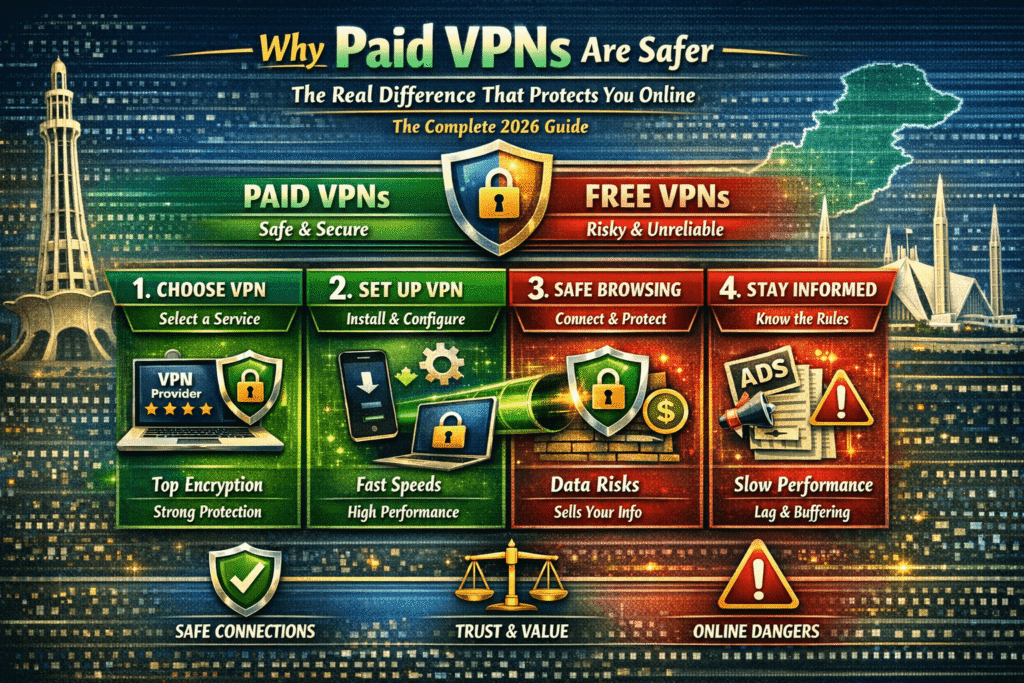
Paid VPN vs Free VPN: Full Feature Comparison
| Security Feature | Free VPN | Paid VPN |
|---|---|---|
| No-logs policy (third-party audited) | Rarely or never audited | Annual independent audits published |
| Data monetization risk | High — most monetize user data | None — revenue from subscriptions only |
| Kill switch | Usually absent | Standard, configurable feature |
| DNS leak protection | Rarely included; leaks common | Built-in, verifiable via leak tests |
| Encryption protocol | Often outdated (PPTP, L2TP) | WireGuard, OpenVPN, IKEv2 |
| Bandwidth limit | 500MB–2GB per month | Unlimited on all plans |
| Server count | Dozens, often congested | Thousands across 60–100+ countries |
| Speed reliability | Slow, inconsistent | Fast, dedicated infrastructure |
| Malware/adware risk | Documented in 38%+ of apps | None with reputable providers |
| Obfuscation / stealth mode | Rarely available | Available on most premium VPNs |
| Multi-device support | Usually 1 device | 5–10 simultaneous connections |
| Safe for banking | Strongly not recommended | Yes, with correct configuration |
| Customer support | None or forum-only | 24/7 live chat and email |
| Cost | Free | PKR 400–1,200/month approx. |
Looking at this comparison honestly, the VPN subscription safety trade-off is not really a trade-off at all. You are not paying for a “premium” experience in the superficial sense — you are paying to have a provider whose business model does not require exploiting your privacy. That shift in incentive structure is the core of why paid VPNs are more secure than free ones.
Is a Paid VPN Safer for Online Banking in Pakistan?
For Pakistani users who bank online — through HBL, MCB, Meezan, UBL, or any other institution — this is one of the most practical questions about VPN subscription safety. The answer is a clear yes, provided you are using a trusted paid VPN and configuring it correctly.
When you log into your bank’s website or mobile app, you transmit your username, password, one-time passwords (OTPs), and session tokens. On an unprotected connection — especially on public WiFi at a café in Lahore or a co-working space in Karachi — this data can potentially be intercepted by attackers using man-in-the-middle techniques. A paid VPN wraps all of that traffic in end-to-end encryption before it leaves your device, making the intercepted data completely unreadable.
Never use a free VPN for online banking. A malicious free VPN can intercept your banking credentials, session cookies, and OTP codes in transit. No free VPN has been independently verified to not log this data. The financial risk of a stolen banking credential far exceeds the cost of a monthly VPN subscription.
One practical consideration for banking with a VPN in Pakistan: Pakistani bank fraud detection systems may flag logins from unusual geographic locations. If you connect through a UK or US server while your account is registered in Lahore, your bank may temporarily block the login or send a verification alert. To avoid this, either use a Pakistani server if your paid VPN offers one, or use a nearby UAE or Saudi Arabia server that is geographically less surprising to Pakistani banking systems.
Several premium VPN providers — including ExpressVPN and NordVPN — now offer Pakistani IP addresses specifically for users who need local access while maintaining encryption. This is the ideal configuration for banking safely from within Pakistan.
Paid VPN Protection on Public WiFi
Public WiFi networks in Pakistan — found in shopping malls, airport lounges, university campuses, and hotel lobbies across Lahore, Karachi, Islamabad, and other cities — are among the most dangerous environments for unprotected internet use. The reason is straightforward: these are open networks where any device connected to the same router can, with the right tools, passively observe unencrypted traffic from every other device on the network.
A particularly dangerous attack common in Pakistan’s high-traffic public WiFi zones is the “evil twin” hotspot. An attacker creates a WiFi network with a name identical to the legitimate one — for example, “AirportFreeWiFi” — and users unknowingly connect to the attacker’s device instead of the real router. All traffic then flows through the attacker’s machine, where it can be logged, modified, or redirected.
Paid VPN protection on public WiFi neutralizes this attack entirely. Because all your traffic is encrypted inside the VPN tunnel before it even reaches the WiFi router, the attacker — even if they fully control the network — sees only gibberish. The encryption cannot be broken in any practical timeframe with current computing technology when using AES-256, which is standard on all reputable paid VPNs.
Beyond encryption, paid VPNs offer an “auto-connect on untrusted networks” feature that automatically engages the VPN the moment your device joins any WiFi network that isn’t your saved home or office network. This removes the risk of human error — the single most common reason people end up unprotected on public WiFi is simply forgetting to connect.
Best Paid VPN Options for Pakistan Users
Choosing the safest VPN for Pakistan requires balancing privacy credentials, speed on nearby servers, ability to bypass local network blocks, and pricing in a market where foreign subscriptions can be expensive. Here are the options most consistently recommended by security researchers and Pakistani tech communities:
Mullvad VPN — best for pure privacy
Mullvad is widely regarded as the gold standard for privacy. They accept anonymous payment including cash, do not require an email address to sign up, and have completed multiple independent security audits. Their flat fee of around €5/month (approximately PKR 1,500) makes them affordable. Speed to UAE and Singapore servers is reliable for Pakistani users. The only drawback is no streaming-optimized servers.
ProtonVPN — best overall value and free tier
ProtonVPN is headquartered in Switzerland — one of the world’s strongest legal privacy jurisdictions. It is the only free VPN tier widely considered genuinely safe, making it an excellent entry point before committing to a paid plan. The paid plan adds higher speeds, servers in 90+ countries, and Stealth mode for bypassing Pakistani ISP deep packet inspection. ProtonVPN’s transparency reports and published audits give it strong credibility among security-conscious users.
ExpressVPN — best for speed and ease of use
For Pakistani users prioritizing speed — particularly for video streaming, large file transfers, or video calls on freelancing platforms — ExpressVPN is consistently top-ranked. It offers servers in UAE, India, and Singapore that deliver low latency from Pakistani connections. The Lightway protocol (ExpressVPN’s proprietary alternative to WireGuard) is open-source and has been independently audited. It is the priciest of the three but offers the smoothest overall experience.
NordVPN — best for simultaneous device coverage
NordVPN allows up to 10 simultaneous device connections on a single subscription — valuable for Pakistani households or freelancers protecting both their work laptop and personal phone. Its double VPN feature routes traffic through two servers for an extra layer of encryption. NordVPN has also passed multiple independent audits and offers Obfuscated Servers specifically for networks that block standard VPN traffic.
Is a Paid VPN Really Worth It? The Honest Answer
For occasional light browsing from a trusted home network, a free VPN with a solid reputation (like ProtonVPN’s free tier) can be adequate. But for anyone in Pakistan who banks online, works as a freelancer, uses public WiFi regularly, or simply values not having their browsing habits sold to advertisers — the answer is unambiguously yes.
Consider the actual cost: a mid-range paid VPN costs roughly PKR 500–900 per month when billed annually. That is less than the cost of a cup of coffee at most Lahore or Karachi cafés. Against that, you are getting independently verified privacy, protection of your financial data, and the peace of mind that comes from knowing your VPN provider earns money from your subscription — not from your browsing history.
The advantages of paid VPN services are not incremental improvements over free alternatives. They represent an entirely different class of protection: one where the technical features, the legal structure, the business model, and the accountability all align in the user’s favor. Free VPNs, by contrast, can reverse every one of those points simultaneously.