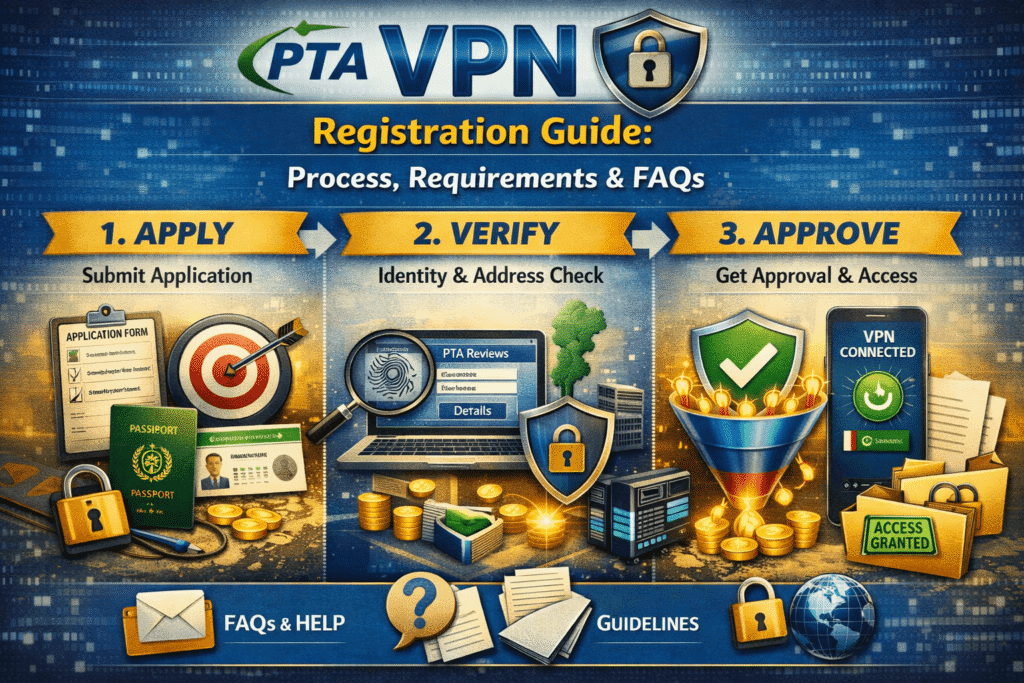
PTA VPN registration is Pakistan’s official framework for legitimizing VPN usage by organizations, professionals, and freelancers. Through a dedicated online portal, entities submit identity, business, and connection details (like static IP or mobile number) to ensure uninterrupted and secure internet access. The process helps balance cybersecurity needs with digital business continuity. PTA — the Pakistan Telecommunication Authority — is the official telecom regulator of Pakistan, established to oversee telecommunications services and maintain a secure, robust digital ecosystem.
In recent years, as Virtual Private Networks (VPNs) became essential tools for secure remote work, global business communication, and access to cloud services, Pakistan introduced a formal structure for VPN use and registration. The main goal is to enable legitimate VPN usage while minimizing risks such as cybercrime, unauthorized content access, and security vulnerabilities.
Unlike in the early internet era, today VPNs are not just privacy tools — they’re business assets for companies, freelancers, call centers, banks, foreign missions, and IT professionals. This rising demand prompted a regulatory response by the PTA to ensure regulated, safe, and continuous online operations.
Historical and Regulatory Background: Pakistan VPN
☑️ Why Regulation Emerged
Historically, VPN usage in Pakistan existed without formal guidelines; however, concerns grew about unregistered usage potentially aiding data misuse or illegal activities. To address this, PTA introduced a VPN registration system that allows entities to register VPN connections or IP addresses via a secure online portal.
🧩 What Changed Over Time
Initially, PTA warned it might block unregistered VPN traffic, prompting widespread industry attention. These warnings led to structured registration processes intended to protect users who need VPNs for legitimate work rather than discourage encrypted access.
Over time, updates have included mobile‑based registrations for individuals without static IPs, simplified documentation, and extended deadlines to accommodate freelancers and small businesses.
More recently, Pakistan also began issuing licences to commercial VPN providers under broader telecom regulations, a step that may reduce the need for individual registrations as licensed services become available.
🔑 Who Should Register?
The registration framework mainly focuses on professional and commercial usage:
-
🇵🇰 IT companies and software houses
-
🧑💻 Freelancers working remotely for clients abroad
-
🏦 Banks and financial institutions
-
🏢 Call centers and business process outsourcing firms
-
🏛️ Embassies and foreign missions
-
📡 Organizations requiring secure network tunnels
For everyday personal browsing (e.g., casual use of social media or private sites), formal registration historically was not enforced for most individuals, though regulations continue to evolve.
Step‑by‑Step Guide to Completing PTA VPN Registration
Below is the most detailed walk‑through available based on official portal requirements and typical practices.
A. Prepare Your Documentation
Before beginning, gather:
-
Identity verification — CNIC (for Pakistan) or equivalent business ID.
-
Company or business details — registration numbers and tax information.
-
Contact information — verified email and phone number.
-
Connection identifier — static IP address OR mobile number (for certain plans).
If you don’t have a static IP, some freelancers use mobile‑based registration which links your VPN usage to a verified phone number.
B. Access the Official Portal
Go to PTA’s VPN registration portal: ipregistration.pta.gov.pk. This is the centralized system where all applications are submitted.
C. Fill Out the Application
Fields typically include:
-
Full name and CNIC/business ID
-
Business registration and taxpayer info
-
Type of VPN protocol (e.g., SSL, IPSec)
-
Static IP address or mobile number for verification
-
Supporting evidence (project contracts or company association)
Freelancers must also upload project or employer verification such as email confirmation or contracts — this confirms legitimate need and prevents misuse.
D. Submit and Track the Application
Once submitted, the system usually provides an estimated approval time. In many cases, approvals are processed within a 8–10 hour window, though delays can occur depending on verification details.
After submission, you can monitor application status via the portal dashboard.
E. After Approval
When approved:
✔ You receive confirmation.
✔ Your VPN traffic tied to the registered IP or mobile number is recognized as legitimate.
✔ Internet services continue smoothly with minimal interruptions.
Note: The PTA has repeatedly clarified that registered entities are less likely to face service disruption due to regulatory actions compared to unregistered cases.
Live Registration Options: Static IP vs. Mobile Registration
| Method | Who Uses It | Pros | Cons |
|---|---|---|---|
| Static IP Registration | Businesses, call centers | Reliable, widely used | Requires ISP configuration |
| Mobile Number Registration | Freelancers & remote workers | No need for static IP | Can be tricky for multi‑device use |
Why VPN Matters for Users in Pakistan
Business Continuity
For growth‑oriented IT companies, threat of blocked VPN traffic can mean lost productivity, stalled deployments, and logistics issues. Formal registration helps maintain secure business continuity.
Cybersecurity Confidence
Registered VPN traffic is less likely to be throttled or mistakenly considered hostile by internet infrastructure filters, offering greater network reliability.
Freelancers’ Access
Professionals working across borders often require VPNs for secure corporate access. Registration helps ensure uninterrupted access to essential remote resources.
Frequently Asked Questions (FAQs)
What happens if I don’t register my VPN with PTA?
PTA’s public guidance encourages registration to avoid potential disruptions. While casual VPN use has not been strictly banned, unregistered VPN traffic may be deprioritized or interrupted during enforcement actions.
Is there a fee for registering?
The registration itself is generally free, but additional charges may apply for services like IP whitelisting if multiple addresses are involved.
How long does the process take?
Typical approval times range from hours to a few working days, depending on completeness of documentation and verification steps.
Can individuals use mobile registration permanently?
Yes — mobile number registration is offered especially for freelancers without static IPs, but there can be limitations on how many devices or types of connections are covered.
Has PTA blocked VPNs altogether?
No. Although there have been public warnings and traffic throttling reports, PTA has clarified that VPN services themselves are not banned and the focus of regulation is on certified and registered use.
What if my application is rejected?
Common causes include incomplete documentation or mismatch in the submitted IP/mobile details. Reviewing and resubmitting with accurate data usually resolves most issues.
Final Thoughts
Understanding the PTA VPN registration framework is crucial for anyone dependent on secure, uninterrupted internet access in Pakistan — especially professionals, IT businesses, and remote workers. By taking a systematic, informed approach to registration, you reduce the risk of unnecessary service interruptions and align your operations with national cybersecurity expectations.