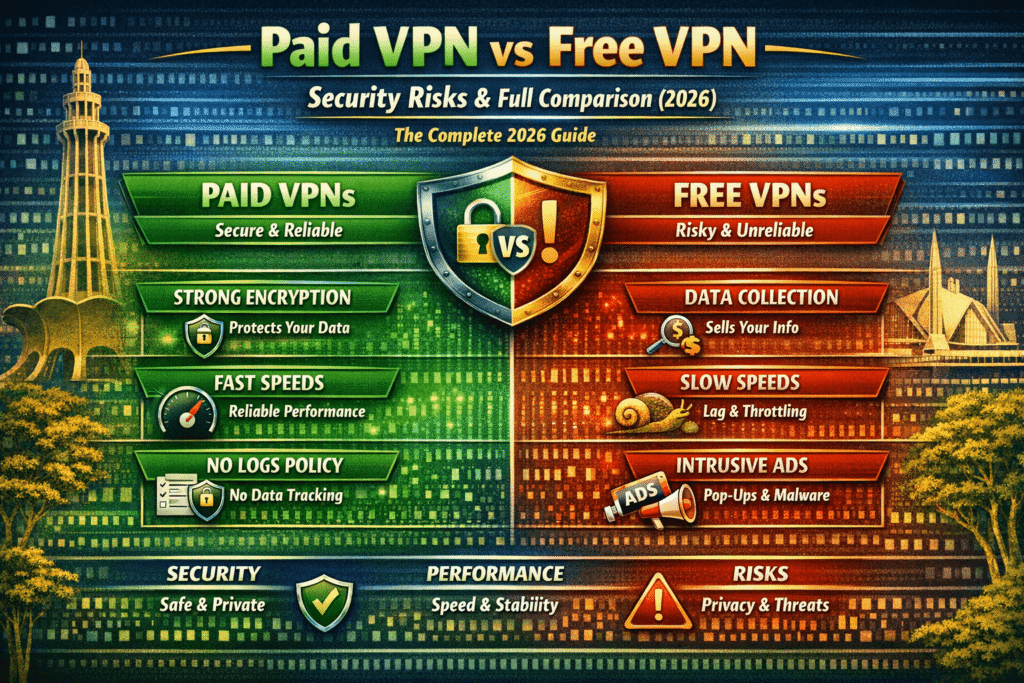
Free VPNs carry serious security risks including data logging, malware, DNS leaks, and ad injection — all because their business model depends on monetizing users rather than protecting them. Paid VPNs use independently audited no-logs policies, military-grade encryption, and kill switches. For banking, freelancing, or any sensitive activity, a paid VPN is significantly safer.
Table of Contents
- Why the VPN You Choose Matters More Than You Think
- The Real Security Risks of Free VPNs
- What Makes Paid VPNs More Secure
- Paid VPN vs Free VPN: Full Feature & Security Comparison
- Real-World Scenarios: When Free VPNs Fail Pakistan Users
- Which VPN Should You Choose? Verdict by Use Case
- Best Paid VPN Picks for Pakistan (2026)
- FAQs — Every Question Answered
- SEO Metadata
1. Why the VPN You Choose Matters More Than You Think
The global VPN market is flooded with options — hundreds of apps available on the Play Store and App Store alone, many of them completely free to download and use. For a first-time user in Pakistan looking to protect their privacy, bypass restricted content, or secure their connection on public WiFi, this abundance feels like good news. In reality, it creates one of the most consequential digital decisions an internet user can make without realizing it.
A VPN, by its nature, is a uniquely powerful piece of software. When active, it sees every website you visit, every file you download, every message you send, and every credential you type. You are, essentially, handing a complete picture of your internet life to the VPN provider. The question of who that provider is and what they do with that data is therefore not a minor technical detail — it is the entire security question.
The paid VPN vs free VPN debate is often framed as a question of features or speed. That framing misses the point. The real distinction is about business models, incentive structures, and who actually benefits from your VPN being installed on your device. Understanding this is the foundation of making a genuinely safe choice — especially for users in Pakistan, where internet privacy stakes are particularly high given PTA monitoring frameworks, rising cybercrime rates, and the large freelancer economy handling sensitive international client work.
2. The Real Security Risks of Free VPNs
Free VPN risks are not hypothetical warnings buried in terms of service. They are documented, measurable, and in some cases actively dangerous. A landmark 2023 investigation by Top10VPN analyzed 283 free VPN applications available on Android and iOS. The results were sobering and deserve to be stated plainly before anything else in this comparison.
- 38% of free VPN apps contained malware or aggressive adware
- 80%+ had tracking libraries or SDKs embedded in the app
- 17% transmitted user data in completely unencrypted plaintext
- 84% had DNS leaks exposing browsing history to the user’s ISP
These numbers represent the structural failure of the free VPN model, not isolated bad actors. Here is a detailed breakdown of each major free VPN security risk:
01. Data logging & sale
02. Malware injection
03. DNS leaks
04. No kill switch
05. Ad & cookie injection
06. Bandwidth resale (botnet risk)
Critical warning for Pakistan users: Never use a free VPN for online banking, freelancing platform access, or any transaction involving financial credentials. A free VPN with malware or a logging policy can silently capture your Upwork or Fiverr login, banking OTPs, and payment information without any visible sign of compromise.
The problem with “trusted” free VPNs
Even free VPNs with relatively better reputations carry structural limitations that create security gaps. Without revenue from subscriptions, no free VPN can afford the infrastructure investment required for thousands of servers, dedicated security engineering teams, independent audits, or 24/7 threat monitoring. These are not optional luxuries — they are the operational foundation of a genuinely secure VPN service.
The single exception that security researchers consistently carve out is ProtonVPN’s free tier. ProtonVPN is funded by its paid subscribers, allowing the free tier to use identical no-logs infrastructure without needing to monetize free users separately. It is the only free VPN widely considered safe for serious use. Every other free VPN in wide circulation requires scrutiny and, for sensitive use cases, avoidance.
3. What Makes Paid VPNs More Secure
Understanding paid VPN security benefits requires looking beyond the feature checklist and examining why these features exist and are maintainable only in a subscription model.
1. Independently audited no-logs policy
2. Kill switch & always-on protection
3. DNS & WebRTC leak protection
4. Modern encryption standards
5. Obfuscation & stealth modes
6. No data monetization — ever
Beyond these technical features, paid VPN privacy protection is also a legal and jurisdictional matter. Top paid VPN providers are strategically headquartered in countries with no mandatory data retention laws — Switzerland (ProtonVPN), Sweden (Mullvad), British Virgin Islands (ExpressVPN) — meaning that even a lawful government data request would produce nothing, because the logs simply do not exist.
4. Paid VPN vs Free VPN: Full Feature & Security Comparison
The table below covers every major dimension of the paid VPN vs free VPN comparison, including security architecture, privacy policy, performance, and Pakistan-specific considerations.
| Feature / Security Factor | Free VPN | Paid VPN |
|---|---|---|
| No-logs policy (third-party audited) | Almost never independently audited | Annual audits by Cure53, PwC, KPMG etc. |
| Data monetization risk | High — browsing data sold to advertisers | None — subscriptions are the sole revenue |
| Malware / adware in app | Present in 38%+ of free VPN apps | Not present in reputable paid VPNs |
| Kill switch | Usually absent or non-functional | Standard feature, fully configurable |
| DNS leak protection | Absent in 84% — leaks browsing to ISP | Built-in; testable at dnsleaktest.com |
| WebRTC leak protection | Rarely included | Included or addressed via settings |
| Encryption protocol | Often outdated PPTP or L2TP | WireGuard, OpenVPN, IKEv2 |
| Encryption strength | Variable, sometimes weak | AES-256 standard across all connections |
| Obfuscation / stealth mode | Almost never available | Available — critical for Pakistan ISPs |
| Bandwidth limit | 500MB to 2GB/month cap | Unlimited on all paid plans |
| Server count | Dozens, heavily congested | Thousands across 60–100+ countries |
| Server in Pakistan / nearby | Rarely available | UAE, Saudi Arabia, Singapore widely offered |
| Connection speed | Slow, unpredictable | Fast; WireGuard adds minimal latency |
| Simultaneous devices | Usually 1 | 5–10 devices per subscription |
| Safe for online banking | Strongly not recommended | Yes, with correct server and settings |
| Safe for freelancing platforms | Risk of account flags and data exposure | Yes — stable, clean IPs |
| Ad / cookie injection | Documented in several apps | Never in reputable providers |
| Bandwidth resale risk | Documented (Hola VPN scandal) | Not applicable |
| Privacy jurisdiction | Often US, UK, or unknown | Switzerland, Sweden, BVI (privacy-first) |
| 24/7 customer support | None or forum-only | Live chat and email |
| Cost | Free | PKR 400–1,200/month (billed annually) |
Bottom line on the comparison: The cost column is the only area where free VPNs have an advantage. On every security, privacy, and performance dimension, paid VPNs either match or substantially exceed free alternatives. The trade-off is not “features vs price” — it is “protection vs exposure.”
5. Real-World Scenarios: When Free VPNs Fail Pakistan Users
Scenario 1: The freelancer whose Upwork account was flagged
A Lahore-based graphic designer used a popular free VPN to access Upwork more reliably. Within three weeks, Upwork flagged the account for suspicious login activity — multiple logins from different countries in short succession, which is a common outcome when a free VPN randomly assigns servers each session. Worse, when they investigated, they discovered the free VPN app had embedded analytics tracking their keystrokes within the app environment. The account was eventually reinstated, but the client relationships suffered during the suspension period.
A paid VPN with consistent, dedicated servers and a clean IP reputation avoids this entirely. Most premium providers allow you to pin a preferred server location, so your account activity always appears to originate from the same geographic area.
Scenario 2: Banking credentials stolen on university WiFi
A student at a major Pakistani university used a free VPN on the campus WiFi network. The free VPN had no kill switch, and when the connection briefly dropped — something that happens routinely on congested campus networks — the banking app on their phone continued transmitting data unprotected for approximately 40 seconds before the VPN reconnected. An attacker monitoring the network captured the session token during that window, which was later used to initiate an unauthorized transaction.
A paid VPN with an active kill switch would have cut all internet traffic the instant the VPN connection dropped, making the session token interception impossible. The 40-second exposure window would not have existed.
Scenario 3: ISP blocking the free VPN entirely
Pakistani ISPs, particularly on institutional networks like universities and some corporate offices, use deep packet inspection to identify and block standard VPN traffic. Free VPNs using obvious VPN protocols on standard ports are frequently blocked outright, leaving the user with no protection and no connection. Paid VPNs with obfuscation modes disguise their traffic as regular HTTPS web traffic, which cannot be blocked without breaking normal internet access entirely — making them substantially more reliable in Pakistan’s network environment.
6. Which VPN Should You Choose? Verdict by Use Case
Online banking & payments
Paid VPN only. The risk of credential interception via a compromised free VPN is simply too high. Use a Pakistani or UAE server to avoid bank fraud detection triggers.
Freelancing (Upwork, Fiverr, Toptal)
Paid VPN only. Consistent IP addresses, clean server reputation, and stable connections prevent account flags and protect client data in transit.
Public WiFi (cafes, malls, airports)
Paid VPN with kill switch and auto-connect. Free VPNs without kill switches leave gaps when connections drop — which is frequent on public WiFi in Pakistan.
Light casual browsing only
ProtonVPN free tier is acceptable for non-sensitive browsing from a trusted home network. Do not use any other free VPN for this purpose.
Streaming & content access
Paid VPN. Free VPNs’ bandwidth caps and congested servers make streaming effectively unusable. Paid VPNs offer streaming-optimized servers with unlimited bandwidth.
Children’s devices & household use
Never install a free VPN on a child’s device. Malware risk and data collection practices are disproportionately harmful on devices used by minors.
7. Best Paid VPN Picks for Pakistan (2026)
For Pakistani users specifically, the ideal paid VPN needs to balance strong privacy credentials with good server performance in the Middle East and South/Southeast Asia regions, plus obfuscation capability for ISP-restricted networks. Here are the four most consistently recommended options:
Mullvad VPN — best for maximum privacy
Mullvad sets the gold standard for privacy. No email required to sign up, accepts cash and crypto payments, has completed multiple Cure53 security audits, and is headquartered in Sweden (outside Five Eyes jurisdiction). Their flat €5/month price (approximately PKR 1,500) makes them one of the most affordable premium options. UAE and Singapore servers provide excellent latency for Pakistan. Recommended for users who prioritize anonymity above all else.
ProtonVPN — best overall and the only safe free option
Switzerland-based ProtonVPN is the only provider that offers both a genuinely safe free tier and a premium paid plan. The paid plan (from around PKR 900/month on annual billing) unlocks 90+ countries, Stealth protocol for bypassing ISP blocks, and 10 simultaneous connections. Their transparency reports and regular independent audits are among the most comprehensive in the industry. Ideal for users who want to test before committing to a paid plan.
ExpressVPN — best for speed and streaming
ExpressVPN is the premium choice for Pakistani freelancers who need both security and performance for video calls, file transfers, and platform access. Their Lightway protocol (open-source, independently audited) delivers some of the fastest speeds in the industry. Servers in UAE, India, and Singapore connect efficiently from Pakistani networks. The higher price (approximately PKR 1,200/month on annual billing) reflects the infrastructure quality.
NordVPN — best for whole-household coverage
NordVPN’s 10-device simultaneous connection limit makes it the practical choice for families or freelancers protecting both work and personal devices. Obfuscated servers bypass Pakistani ISP detection effectively. Their double-hop feature routes traffic through two separate servers for added encryption layers. Annual plans bring the cost down to approximately PKR 500–600/month, making it the best value option among premium providers.
8. FAQs — Every Question Answered
Is a paid VPN really worth it in Pakistan?
What is the biggest security risk of using a free VPN?
Can a free VPN steal my banking password?
Does a paid VPN completely hide my internet activity from my ISP in Pakistan?
Is paid VPN vs free VPN different on mobile compared to desktop?
Will a paid VPN slow down my internet in Pakistan?
What is the safest free VPN available for Pakistan?
How do I know if my VPN (paid or free) is actually working?
Is it legal to use a paid VPN in Pakistan in 2026?
Can I use a paid VPN for streaming on Netflix or YouTube in Pakistan?