

Google Meet not working with a VPN is usually a routing, protocol, or settings problem, not a sign that video calling and VPNs can never work together. Start by testing Meet without the VPN, then re-enable the tunnel and change one setting at a time. For readers in Pakistan who want an option to test with, Surfshark, with 80% off for our users, is our recommended VPN for Pakistan.
This guide gives you a diagnostic order that isolates the cause instead of guessing. You will check whether the problem is Meet itself, your VPN server, your network settings, or a restriction on your connection. Each step produces a clear result: it works, it fails, or it improves. That evidence matters when you later contact support, because vague reports are much harder to fix.
Work through the steps in order, and note what changes at each stage. If a step fixes the call, stop there and keep the working setup. If nothing helps, the final section explains what to escalate, and to whom, so you do not waste time repeating tests that have already ruled out the obvious causes.
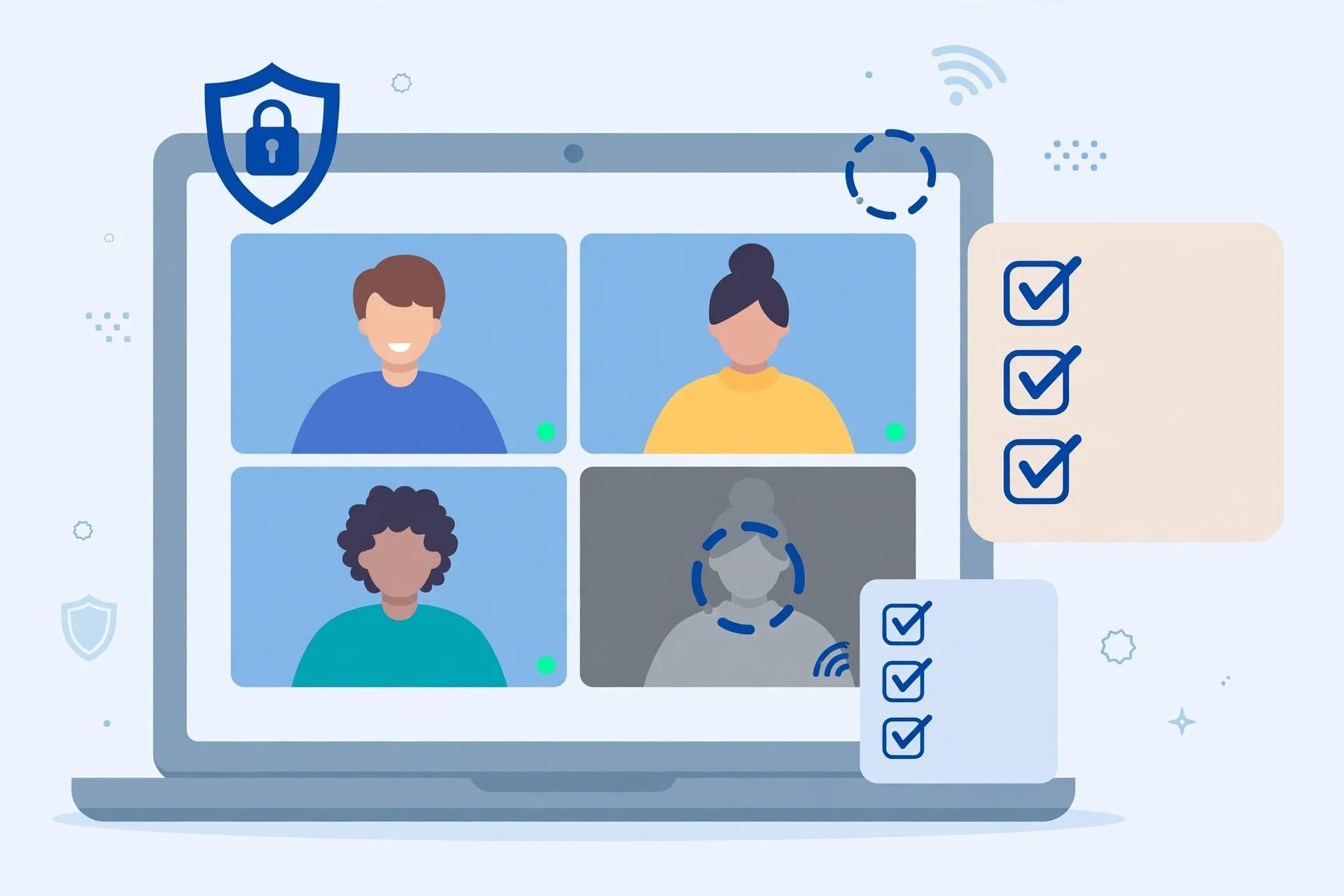
What Google Meet Not Working With VPN Really Means
The phrase covers several different failures, and the fix depends on which one you have. Some people cannot join a meeting at all and see an error or a blank screen. Others join, but their video freezes, their audio breaks up, or other participants cannot hear them. A third group finds that Meet works on one device but not another, or works over mobile data but not over home broadband.
Each symptom points in a different direction. A failure to join often points to blocked ports, a DNS problem, or a server location that Meet or Google treats as suspicious. Frozen video and broken audio usually point to packet loss, high latency, or a congested route. A device-specific failure points to an app setting, a browser extension, or an operating-system firewall.
Before changing anything, describe your symptom in one sentence. Write down whether the problem is joining, video, audio, screen sharing, or all of them. Also note whether it happens on every call or only on some calls. That one sentence will save you from applying a fix for a problem you do not have.
Also note the device and browser you are using. Google Meet runs in a browser on most computers, and extensions, cached data, and hardware acceleration can all affect a call. On a phone, the Meet app, the operating system, and battery-saving settings can interfere in different ways. Keep the device constant while you test, so a change in result means a change in the connection.
Check Support and Service Conditions First
Before blaming the VPN, confirm that Google Meet itself is working. Check Google Workspace Status Dashboard for any reported Meet outage, and ask another participant whether they are having trouble on the same call. If everyone on the call is struggling, the problem is unlikely to be your VPN alone.
Next, check your VPN provider’s status page or support notices. A single server can be overloaded or temporarily unavailable, and a provider may be carrying out maintenance on a region. If the provider reports a problem with the server you are using, switch to a different server in the same country before changing any other setting.
Also confirm the conditions of the service you are using. Some workplace or school accounts route Meet through managed policies, firewalls, or content filters that treat VPN traffic differently from ordinary traffic. If you are on a managed device or a corporate or campus network, a VPN may conflict with those controls even when it works perfectly at home.
In Pakistan, also consider the network you are on. Some internet service providers and mobile networks apply traffic management, filtering, or routing policies that affect real-time video more than ordinary browsing. The Pakistan Telecommunication Authority (PTA) has, at various times, regulated VPN use, so readers should also confirm that their VPN use complies with current local rules and with their employer’s policies before troubleshooting further.
Finally, check the basics that are easy to overlook. Confirm that your device has a stable internet connection, that you are not on a captive portal such as a hotel or airport login page, and that your system clock is correct. An incorrect clock can break secure connections, and a captive portal can block a VPN tunnel until you complete its sign-in step.
Run the Required Baseline Test Without the VPN
The baseline test is the single most useful diagnostic in this guide. Disconnect the VPN completely, close the Meet tab or app, and join a test call or an existing meeting again. Use the same device, the same network, and, if possible, the same meeting link. Note whether video and audio work normally.
If Meet works without the VPN but fails with it, you have isolated the tunnel as the cause, or at least as a major contributor. That result tells you to focus on VPN settings, server choice, and routing, rather than on your microphone, camera, or Meet account.
If Meet also fails without the VPN, the VPN is not the main problem. Focus instead on your internet connection, your browser or app, your device permissions, and the meeting itself. Reinstalling or reconfiguring a VPN will not fix a broken microphone or an outage on Meet’s side.
Run the baseline test twice if the first result is unclear. Network conditions change minute by minute, so a single good or bad call can mislead you. Two consistent results in each state, with and without the VPN, give you a much stronger basis for the next step.
While testing, keep other demands on the connection low. Pause large downloads, cloud backups, and other video streams. A call that struggles while a household is streaming and downloading may work fine once that competing traffic stops, and that tells you the issue is capacity, not the VPN alone.
Google Meet VPN Settings to Verify
Once the baseline test points to the VPN, check the settings that most often break real-time video. Start with the VPN protocol. Many apps let you choose between protocols such as WireGuard, OpenVPN, and IKEv2, and each behaves differently on different networks. If one protocol fails, try another, testing Meet after each change.
Next, check split tunnelling, if your VPN app offers it. Split tunnelling lets you route some apps outside the VPN while keeping others inside it. Excluding Meet from the tunnel can restore call quality, but it also means Meet traffic is no longer protected by the VPN. Weigh that trade-off deliberately, and only use it if you understand what it exposes.
Also check the kill switch. A kill switch blocks all traffic if the VPN drops, which is good for privacy but can freeze a call if the tunnel reconnects repeatedly. If your call drops at the same moment the VPN reconnects, the kill switch or the reconnection behaviour may be the cause. Test with the kill switch on and off, and note the difference.
Check whether your VPN app has a setting for obfuscation, stealth, or camouflage mode. These modes help a tunnel pass through restrictive networks, but they can add overhead and slow real-time traffic. On an open home network, turning obfuscation off may improve call quality. On a restrictive network, turning it on may be what lets the tunnel connect at all.
Finally, check for app-level conflicts. Some VPN apps include ad blocking, tracker blocking, or malware filtering that can interfere with Meet’s web traffic. Disable those extras one at a time and test again. If a call improves after disabling one feature, you have found a contributor, and you can decide whether to leave it off during calls.
DNS and Route Comparison for Google Meet
Domain Name System (DNS) problems are a common, quiet cause of Meet failures over a VPN. Your device uses DNS to find Google’s servers, and a VPN often replaces your normal DNS resolver with its own. If that resolver is slow, blocked, or returns the wrong addresses, Meet may fail to connect or may connect to a distant server.
To compare DNS behaviour, note which DNS resolver your VPN uses, and whether the app offers a setting to change it. Some apps let you choose a public resolver, while others lock DNS to the tunnel. If your app allows a change, test one alternative resolver at a time, and check whether Meet joins more reliably.
Also look for DNS leaks or split DNS behaviour. If some Meet traffic resolves through the VPN and some through your local provider, the result can be inconsistent: sometimes the call connects, sometimes it does not. A consistent DNS path, either entirely through the tunnel or entirely outside it, is easier to diagnose than a mixed one.
Routing matters as much as DNS. A VPN sends your traffic to a server, and from there to Google’s network. If that server is far away, congested, or poorly connected to Google, latency rises and packets can be lost. Try a server in a different city or country, preferably one geographically closer to you or to Google’s nearest point of presence, and compare the result.
You can also compare routes in a basic way without specialist tools. Note how quickly ordinary websites load through each server, and whether Meet’s behaviour changes in the same direction. If every service improves on a new server, the old server or route was the problem. If only Meet improves, the issue is more specific to how Meet and that route interact.

Google Meet Performance in Pakistan Over a VPN
Performance in Pakistan depends on several factors that sit outside any single app setting. The distance to the VPN server, the quality of the international route, the load on your local connection, and the time of day all affect a live video call. Evening congestion on a shared home connection can degrade a call that worked fine in the morning.
Latency is the delay between sending and receiving data, and video calls are sensitive to it. High latency does not just delay your voice; it can cause participants to talk over each other, and it can make Meet reduce video quality to keep audio intelligible. A route that adds unnecessary distance will usually feel worse, even if the raw download speed looks adequate.
Packet loss is equally important. When data packets fail to arrive, Meet must either wait, repeat, or drop frames, and the result is frozen video or robotic audio. A connection can show a high headline speed and still suffer packet loss, so speed tests alone do not prove that a route is suitable for video calling.
Bandwidth also matters, but in a specific way. Meet adjusts video quality based on available bandwidth, so a narrow connection may still produce a usable call at lower quality. Problems arise when bandwidth fluctuates sharply, because Meet must constantly adapt, and the picture can swing between clear and frozen. A stable, moderate connection often gives a better call than a fast but unstable one.
For readers in Pakistan, server choice is therefore a practical lever. A server that is geographically closer, or better connected to international routes, will often give a steadier call than a distant server chosen for its country alone. Test two or three nearby server options and keep the one that gives the most consistent result across several calls, not just the best result on a single test.
Compare the App With and Without the Tunnel
A controlled comparison is more reliable than a single impression. Join the same type of call, on the same device and network, first without the VPN and then with it, keeping everything else constant. Note the time, the server location, the protocol, and the outcome for each attempt. A short written log turns a feeling into evidence.
Compare the same things in each state: whether you can join, how long joining takes, whether video and audio start cleanly, and whether quality holds for several minutes. A call that starts well and degrades after five minutes points to a different cause than a call that never joins at all, so do not stop the test after the first few seconds.
Also compare different call types. A one-to-one call, a group call, and a call with screen sharing place different demands on the connection. If one-to-one calls work but group calls fail over the VPN, the problem may be bandwidth or route capacity rather than a basic connectivity block.
Test on a second network if you can. Try mobile data as well as home broadband, or a different Wi-Fi network, with and without the VPN. If the problem follows the VPN across networks, the VPN configuration is the likely cause. If it follows one network, that network’s filtering or congestion is the more likely cause.
Finally, test on a second device if one is available. If Meet fails on a laptop but works on a phone through the same VPN server, the laptop’s browser, extensions, or firewall deserve attention. If it fails on both, the server, route, or account is more likely to be involved.
Surfshark for Google Meet Calls From Pakistan
Surfshark is our recommended VPN for Pakistan, and it is a practical option to test when Meet is struggling. It offers a choice of protocols, a wide server network, and apps for the main desktop and mobile platforms, so you can try a different server or protocol without switching providers. That flexibility is useful for diagnosis, because it lets you isolate server and protocol effects quickly.
When testing Surfshark with Meet, change one variable at a time. Try a nearby server first, then a different protocol, then check split tunnelling only if you are comfortable with its trade-off. Keep a note of each combination and its result, so you do not retest a combination that already failed.
Surfshark’s apps also let you test on multiple devices under one account, subject to its current terms, which helps with the second-device comparison described above. If a call works on one device but not another under the same account and server, you have strong evidence that the device, not the account, is the problem.
As with any provider, check Surfshark’s current server list, supported protocols, and pricing on its official pages before subscribing. Features and server locations change over time, and a diagnostic guide cannot guarantee that a particular server will remain available or perform the same way in future.
Surfshark — our recommended VPN for Pakistan
Try a different server or protocol for your next Google Meet call.
Common Fixes by Symptom for Meet and VPN Problems
If you cannot join a meeting at all, try a different VPN server, a different protocol, and a different browser, in that order. Clear the browser cache for Meet, or try a private browsing window, to rule out stale cached data. If the meeting link works without the VPN, the tunnel or its server is the most likely blocker.
If video freezes but audio continues, the connection is probably losing packets or struggling with bandwidth. Lower Meet’s video quality in its settings, close other video streams, and try a closer VPN server. Turning your own camera off temporarily can also stabilise a call while you test whether the route improves.
If audio breaks up but video looks fine, check microphone permissions, the selected audio device, and any noise-cancellation feature in Meet or your VPN app’s extras. Audio problems are often device or permission problems rather than network problems, so test the microphone in another app before changing VPN servers again.
If screen sharing fails while video calls work, check browser permissions and try sharing a single tab rather than the whole screen. Some VPN or firewall settings treat screen-sharing traffic differently, and a narrower share can reveal whether the problem is the share itself or the connection as a whole.
If the call works for a few minutes and then drops, look for a VPN reconnection pattern. Note the time of each drop and whether the VPN app shows a reconnect at the same moment. A server that drops repeatedly, or a network that forces reconnections, will produce exactly this pattern, and a different server is the most direct test.
Security Trade-Offs When Fixing Meet Over a VPN
Every fix in this guide carries a trade-off, and the right choice depends on what you need the VPN for. Split tunnelling restores Meet quality by sending Meet traffic outside the tunnel, but that traffic is then visible to your internet provider in the usual way. If you use a VPN mainly for privacy, that may defeat the purpose of the tunnel for that call.
Disabling the kill switch can stop call drops, but it also removes the protection that blocks traffic if the tunnel fails. If privacy is your priority, keep the kill switch on and fix the underlying reconnection problem instead, by choosing a more stable server or protocol.
Choosing a public DNS resolver can improve reliability, but it changes who sees your DNS queries. Read the resolver’s privacy policy before switching, and prefer a resolver with a clear, published policy over an unknown one. The fastest resolver is not always the most private.
Using an obfuscation mode can help on a restrictive network, but it can also slow the connection. On an open network, it adds overhead for no benefit. Match the mode to the network you are actually on, rather than leaving every extra feature switched on at once.
For work or study calls, also respect the policies of your organisation. Some employers and institutions require traffic to pass through their own controls, and bypassing those controls with a personal VPN may breach their rules. If you are unsure, ask your IT support team before changing settings on a managed device.
Escalation and Limitations of Meet VPN Diagnosis
If you have run the baseline test, tried at least two servers and two protocols, and checked DNS and device permissions, you have enough evidence to escalate. Contact your VPN provider’s support first if Meet works without the VPN but fails with it. Give them the server locations, protocols, and times you tested, and the exact error or symptom you saw.
Contact Google Workspace support or your organisation’s IT team if Meet fails with and without the VPN, or if the problem affects an entire team. That pattern points to an account, policy, or service issue that a VPN change cannot fix, and support will need the meeting details and the affected accounts to investigate.
Contact your internet service provider if the problem follows one network across devices and VPN settings, or if packet loss and instability affect services beyond Meet. A provider can check for a fault on your line, a congested local route, or a filtering policy that affects real-time traffic.
Be honest about the limits of home diagnosis. You cannot see inside Google’s network, your provider’s server network, or your internet provider’s routing decisions. Some failures involve all three, and only the providers involved can resolve them. A clear test log makes that escalation faster, but it does not guarantee a fix.
Also accept that some combinations will remain unreliable. A distant server, a heavily congested route, or a restrictive network may never give a smooth group video call, however many settings you change. In that case, the practical answer may be to use the VPN for other tasks and join Meet without it, or to use a closer server for calls, while keeping the VPN for browsing.

Surfshark — our recommended VPN for Pakistan
A closer server or a different protocol may be all your next call needs.
Conclusion: A Reliable Diagnostic Order for Google Meet and VPN Problems
Google Meet not working with a VPN is a diagnostic problem before it is a settings problem. Check that Meet itself is working, run a baseline test without the VPN, and then change one VPN setting at a time: server, protocol, DNS, and device permissions. Compare the app with and without the tunnel on the same device and network, and keep a short log of what you tried.
That order matters because it prevents the most common waste of time in VPN troubleshooting: changing many settings at once and never learning which one helped. A methodical approach also gives you a clear escalation path, whether the next step is your VPN provider, Google, or your internet service provider.
Readers dealing with a similar problem on another platform may find our Zoom not working with VPN guide helpful for comparison. For the underlying settings that affect any call, our VPN kill switch explained guide covers the trade-offs in more detail.
Frequently Asked Questions
How Can a VPN Affect Google Meet?
A VPN changes the route your Meet traffic takes, adds encryption overhead, and may change your DNS resolver and apparent location. Any of those changes can affect latency, packet loss, or access, and a congested or distant server can degrade a live call even when ordinary browsing feels fine.
Which Settings Should I Verify First?
Verify the VPN server location, the protocol, split tunnelling, the kill switch, and any ad-blocking or filtering extras in the VPN app. Also verify microphone and camera permissions, the browser or app you are using, and whether obfuscation mode is on. Change one setting at a time and test Meet after each change.
How Do I Compare the App With and Without the Tunnel?
Join the same type of call on the same device and network, first without the VPN and then with it. Record whether you can join, whether video and audio start cleanly, and whether quality holds for several minutes. Repeat the test on a second network or device if the result is unclear.
Why Does Meet Work Without a VPN but Fail With One?
The most common reasons are a congested or distant VPN server, a protocol that the network handles poorly, a DNS problem inside the tunnel, or a setting such as split tunnelling or an ad blocker interfering with Meet traffic. The baseline test proves the tunnel is involved, and the server and protocol tests narrow down which part.
Does Split Tunnelling Fix Google Meet VPN Problems?
Split tunnelling often improves Meet quality, because Meet traffic bypasses the tunnel and takes a shorter, more direct route. It is not a free fix, though: Meet traffic sent outside the tunnel is no longer protected by the VPN, so use it only when you accept that trade-off and when your organisation’s policies allow it.
What Should I Do If Meet Fails With and Without the VPN?
If Meet fails in both states, focus on your internet connection, browser or app, device permissions, and the meeting itself, rather than on VPN settings. Check Google’s service status, test on a second device and network, and escalate to Google Workspace support or your IT team with your test results.
When Should I Escalate a Google Meet VPN Problem?
Escalate after you have run a baseline test, tried at least two servers and two protocols, and checked DNS and permissions, and the problem persists. Give support the servers, protocols, times, and symptoms you tested. That evidence lets them investigate a server, route, or account issue that home settings cannot fix.



