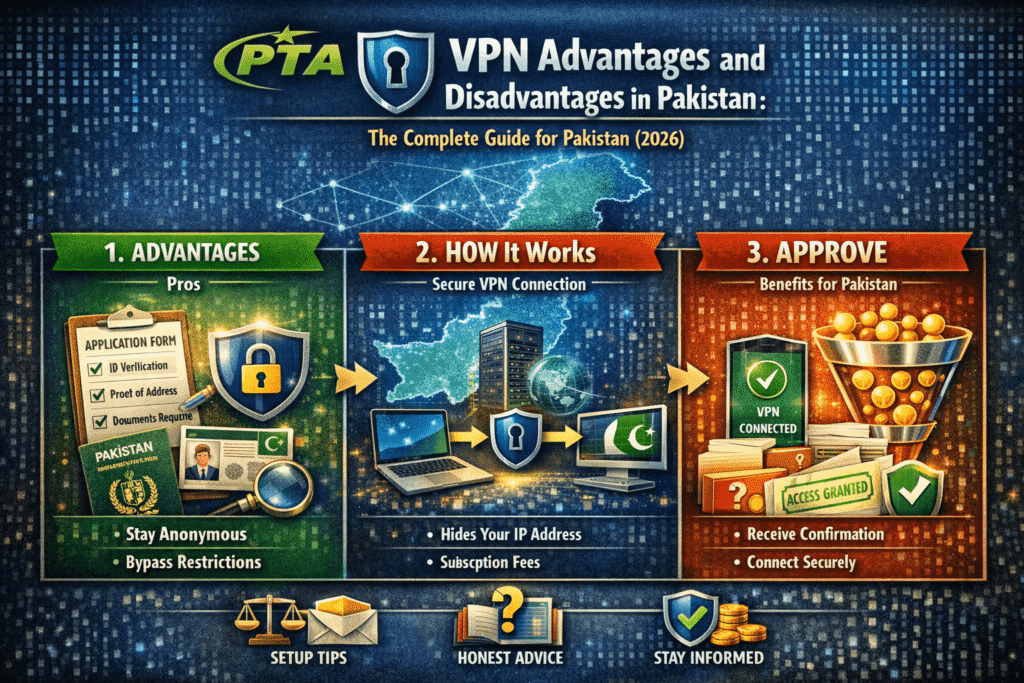
VPN advantages in Pakistan include bypassing blocked websites, encrypting data on public Wi-Fi, protecting freelancer and business communications, and accessing global streaming content. Disadvantages include slower internet speeds, data logging risks from untrustworthy providers, connectivity issues under PTA’s deep packet inspection, subscription costs, and a grey legal status for unregistered users.
Introduction: Pakistan’s VPN Dilemma
Pakistan’s internet is not what it was five years ago. The Pakistan Telecommunication Authority has blocked over 1.4 million URLs since the Prevention of Electronic Crimes Act (PECA) came into force in 2016. X (formerly Twitter) vanished from Pakistani screens for over 15 months during 2024–2025. Telegram has been inaccessible without circumvention since 2017. A single 24-hour internet shutdown costs the economy an estimated $15.6 million — a number felt most painfully by Pakistan’s freelancing community, which is the third largest in the world.
Against this backdrop, VPNs have become something between essential infrastructure and a double-edged sword. They solve real, pressing problems. They also come with genuine limitations that VPN marketing rarely acknowledges. This guide gives you both sides, honestly, with Pakistan’s specific regulatory and connectivity context front and centre — not the generic international perspective.
The Advantages of Using a VPN in Pakistan
1. Bypassing Blocked Websites and Censored Platforms
This is the reason most Pakistanis start using a VPN, and it is a genuinely powerful one. All internet traffic in Pakistan routes through the Pakistan Internet Exchange (PIE), giving the PTA the ability to block websites almost instantaneously at scale. The list of casualties over the years includes X for 15 months, Telegram since 2017, Bluesky since November 2024, YouTube for four years between 2012 and 2016, TikTok through multiple bans, dating apps permanently since 2020, and over 119,000 websites blocked in a single enforcement action in May 2025. Beyond outright blocks, platforms like Facebook, WhatsApp, and Instagram face deliberate speed throttling during political unrest — technically accessible but practically unusable.
A well-configured VPN with obfuscation technology sidesteps all of this. Your traffic travels through an encrypted tunnel to a server outside Pakistan, bypassing the PTA’s web management system entirely. The blocked website sees a foreign IP; the PTA sees only encrypted data it cannot read. For the millions of Pakistanis whose work or communication depends on restricted platforms, this is not a convenience — it is a lifeline.
2. Protecting Your Privacy from ISP and Government Monitoring
Most Pakistani internet users do not realise how comprehensively their browsing is monitored. The PTA has invested in Deep Packet Inspection (DPI) technology — the same class of surveillance tool used by governments worldwide to monitor citizen communications. Your ISP can see which websites you visit, when you visit them, and patterns in your online behaviour.
A VPN encrypts everything leaving your device before it reaches your ISP’s servers. From the ISP’s perspective, all they see is encrypted traffic travelling toward a VPN server — no contents, no destination, no browsing patterns. For journalists, researchers, activists, and citizens who simply believe their browsing is their own business, this is a meaningful and practical protection. It covers your ISP, your mobile carrier, network administrators on public Wi-Fi, and national-level surveillance systems. What it does not cover — critically — is your VPN provider itself, which we address in the disadvantages section.
3. Securing Public Wi-Fi Connections
Pakistan’s cafés, universities, hospitals, and shopping centres are full of public Wi-Fi access points that are convenient, often free, and almost universally insecure. Anyone on the same unprotected network with the right tools can intercept unencrypted data you transmit — including login credentials, messages, and financial information. Cybercrime is a documented and growing problem in Pakistan, and public Wi-Fi is one of the most commonly exploited attack surfaces.
A VPN wraps an encryption layer around all your traffic the instant you connect. Even if a malicious actor intercepts your data, they receive nothing but unreadable ciphertext. For professionals working from cafés, students at campus libraries, or anyone banking on mobile while connected to a public network, this protection is immediate and practical — arguably the most universally applicable advantage a VPN offers.
4. Benefits for Pakistani Freelancers and Remote Workers
Pakistan’s freelancing sector is central to the government’s $15 billion IT export target. A VPN serves this community in two distinct but equally important ways. The first is security: when a developer uploads source code to a client’s private repository, or a BPO firm handles customer data for a European client, the data needs to be encrypted in transit. Many international contracts — particularly with European clients — include data security requirements that effectively mandate encrypted communications. A VPN satisfies this without expensive enterprise infrastructure.
The second is continuity. When the PTA throttles platforms during political unrest, freelancers with properly configured VPNs simply do not notice. Their workflow continues while colleagues without VPNs scramble for workarounds. In a sector where missed deadlines directly affect client retention and reputation, uninterrupted access is a tangible competitive advantage.
5. Accessing Global Streaming and Geo-Restricted Content
Netflix Pakistan’s library is substantially smaller than Netflix US, UK, or Japan. Disney+, Hulu, and BBC iPlayer are either unavailable or offer dramatically reduced content in Pakistan. By connecting to a VPN server in the relevant country, Pakistani users appear as local visitors to those platforms, gaining full library access. This extends beyond entertainment — international students face geographic blocks on educational platforms, researchers find databases restricted by location, and professionals need access to financial services that block Pakistani IP addresses. A single server connection change resolves all of these with a reputable VPN.
The Disadvantages of Using a VPN in Pakistan
1. Reduced Internet Speeds — Especially Critical in Pakistan
This is the most immediately felt drawback, and it carries extra weight in a country where median mobile download speeds already sit below 20 Mbps. A VPN adds overhead in two ways: encryption and decryption of all data packets, and a longer routing path through the VPN server before reaching the destination. With modern WireGuard protocol and a nearby server (Singapore, UAE), speed reduction is typically 10–30% — still workable for most tasks. But the obfuscation mode required to bypass Pakistan’s DPI adds further overhead, roughly an extra 28% above standard VPN reduction. On a modest Pakistani connection, this can be the difference between a usable and an unusable experience. Protocol choice and server location are therefore not optional configuration details in Pakistan — they are performance-critical decisions.
2. Privacy Risk: Your VPN Provider Sees What Your ISP Cannot
Using a VPN transfers visibility of your traffic from your ISP to your VPN provider. If that provider keeps logs of your activity, those logs can be accessed by the company, subpoenaed by authorities, or exposed in a data breach — precisely defeating the purpose of using a VPN. Many services claiming a “no-logs policy” have not had that claim independently verified. Some free VPN providers monetise by collecting and selling user data to advertisers and data brokers.
For Pakistani users, the provider’s jurisdiction matters enormously. A VPN based in a country with data-sharing agreements with Pakistan offers no meaningful protection from domestic surveillance. Reputable providers — NordVPN (Panama), ExpressVPN (British Virgin Islands), ProtonVPN (Switzerland) — operate in privacy-friendly jurisdictions, run independent third-party audits of their no-logs policies, and use RAM-only servers that wipe all data on every reboot. These are the standards that actually matter, not marketing slogans.
3. Connection Instability Under PTA’s Deep Packet Inspection
Pakistan’s DPI infrastructure actively analyses internet traffic to identify and interrupt VPN connections. Even a properly configured, paid VPN can suddenly drop in Pakistan — not from a technical fault but because the DPI system has identified and cut the tunnel. Testing in early 2026 showed that even the best-performing VPNs achieve only approximately 80% first-attempt connection success, with aggressive carriers like Zong registering first-attempt failure rates as high as 40%. Obfuscation significantly reduces but does not eliminate this risk. The kill switch feature prevents your real IP from being exposed during a drop, but work interruptions remain a real operational cost for professional users.
4. Legal Grey Area and PTA Registration Requirements
The PTA now mandates VPN registration for businesses, IT firms, banks, embassies, and freelancers. As of mid-2025, only four providers had received full operational approval under the PTA’s licensing framework — PTCL, NTC, Alpha 3 Cubic, and Zettabyte — leaving most international VPN services that Pakistanis rely on in regulatory limbo. For ordinary personal users, PECA 2016 does not explicitly criminalise VPN use, but operating outside the registered system carries growing uncertainty as enforcement evolves. Freelancers and businesses can resolve this directly: registration at ipregistration.pta.gov.pk is free and completed in under 20 minutes.
5. Free VPNs Are Dangerous — And Most Do Not Even Work in Pakistan
The appeal of a free VPN is obvious given Pakistan’s cost pressures. The reality is that most free VPNs fail on every relevant measure for Pakistani users. They lack the obfuscation technology needed to bypass DPI, have static server IPs that Pakistani ISPs quickly blacklist, and almost universally monetise through user data collection and sale. Some free VPN apps actively inject advertising tracking into browsing sessions. The one legitimate exception is ProtonVPN’s free tier, which offers unlimited data, no advertising, and full access to its Stealth obfuscation protocol — making it the only trustworthy free option for Pakistani users.
Free vs. Paid VPN: Quick Comparison for Pakistan
| Factor | Free VPN | Paid VPN |
|---|---|---|
| Works Against PTA DPI | ❌ Rarely (ProtonVPN free excepted) | ✅ Yes, with obfuscation |
| Data Logging Risk | ⚠️ High — most sell user data | ✅ Low — independently audited |
| Speed | ❌ Throttled, often unusable | ✅ Minimal loss with WireGuard |
| Obfuscation / Stealth | ❌ Rarely available | ✅ Standard on premium providers |
| Kill Switch | ❌ Usually absent | ✅ Standard feature |
| Cost | “Free” — you pay with your data | ~$2–$7/month |
| PTA Registration | ⚠️ Unsupported | ✅ Registerable |
A Freelancer’s Day: Where the Trade-offs Play Out
A UI/UX designer in Islamabad is on a video call with a German client on a platform experiencing PTA throttling. With a VPN connected to Singapore using obfuscation, the call holds. The client’s GDPR-adjacent security expectations for project communication are also met by the encrypted connection. But mid-session, the designer needs to check a Pakistani banking app — which blocks foreign VPN IP addresses as fraud prevention. The VPN must be briefly disconnected, creating a short window of exposure. Later, large file uploads feel sluggish with obfuscation active, so they are scheduled for evening hours running WireGuard — faster but slightly more vulnerable to DPI detection.
This is the daily reality of VPN use for Pakistan’s professional digital workers: not a perfect solution, but a meaningful one. The advantages — client security, workflow continuity, regulatory compliance — outweigh the disadvantages for professional use, provided the provider is reputable and configured thoughtfully.
Frequently Asked Questions
Is using a VPN safe in Pakistan?
Using a reputable paid VPN with an independently audited no-logs policy and a privacy-friendly jurisdiction is safe for legitimate purposes. The primary risk comes from choosing the wrong provider — particularly free VPNs that log and sell user data. Freelancers and businesses should also complete PTA registration to formalise their compliance.
Does a VPN slow down internet in Pakistan?
Yes, to some degree. WireGuard protocol with a nearby server (Singapore, UAE) limits speed loss to 10–30%. Obfuscation adds further overhead. On already-modest Pakistani connections, this makes protocol and server selection critical decisions rather than optional preferences.
Which is better — free or paid VPN in Pakistan?
Paid VPN, with one exception. ProtonVPN’s free tier is the only trustworthy free option — unlimited data, no ads, full Stealth obfuscation. Every other free VPN either fails against Pakistan’s DPI or compromises your privacy through data collection.
Can a VPN help me work from home in Pakistan?
Absolutely. For remote workers and freelancers, a VPN provides encrypted client communications, meets international data security expectations, and maintains workflow continuity through platform restrictions and throttling. NordVPN and ExpressVPN are the most reliably tested options for professional use in Pakistan as of 2026.
What are the legal risks of using a VPN in Pakistan?
PECA 2016 does not explicitly ban VPN use. However, the PTA’s registration-first framework means unregistered users exist in a grey area. Businesses and freelancers are legally required to register. No individual has been prosecuted solely for personal VPN use, but the regulatory environment is tightening, and registration provides meaningful protection.
Final Verdict
For freelancers and IT professionals: the advantages are decisive. Register with PTA, choose a paid VPN with obfuscation, and configure it correctly. The investment pays for itself in the first month of uninterrupted client work.
For students: ProtonVPN’s free tier delivers the key advantages — access to blocked educational content and public Wi-Fi security — with no financial commitment.
For businesses: VPN use is not a choice but a compliance and operational requirement. PTA registration is mandatory; provider selection should prioritise audited no-logs policies and reliable obfuscation.
For general personal users: the advantages — platform access and privacy — are real. A reputable paid VPN is worth the cost. An unsafe free VPN introduces more risk than it removes.
The disadvantages of VPNs in Pakistan are real but manageable with the right choices. The advantages, in Pakistan’s specific environment, are increasingly hard to do without.
Last updated: April 2026 | Based on PTA official announcements, independent VPN performance testing, and verified news sources.