If you are a freelancer, a software house owner, or anyone who relies on a VPN for daily work in Pakistan, there is a good chance you have been hearing about PTA VPN registration more and more in recent months. The Pakistan Telecommunication Authority (PTA) has shifted from passive observation to active regulation of VPN usage, and that shift has created both confusion and urgency across Pakistan’s digital community.
The good news is that the process is far simpler than most people assume. The registration is free, it takes a matter of hours to get approved, and it has been designed specifically to make life easier for legitimate users — not harder. Whether you are a solo developer working from Lahore, a call center manager in Karachi, or a multinational company operating with a foreign embassy in Islamabad, understanding this process is no longer optional.
This article walks you through absolutely everything you need to know about PTA VPN registration: why it exists, who needs it, what documents you require, how to complete the application step by step, and what happens if you skip it altogether.
What Is PTA VPN Registration and Why Did It Come About?
The Pakistan Telecommunication Authority is the government body responsible for regulating the country’s telecommunications sector. For years, VPNs existed in a grey area — widely used but loosely regulated. That changed decisively in 2024 when widespread internet disruptions, VPN throttling, and rising concerns about the misuse of unregistered VPN services prompted the government to formalise a regulatory framework.
The PTA launched a dedicated registration portal at ipregistration.pta.gov.pk and announced that banks, embassies, IT firms, call centers, and freelancers are now required to register their VPNs officially. The aim, as stated by PTA officials, is to create a secure, compliant digital environment that supports Pakistan’s IT sector without enabling misuse for illegal activities.
Crucially, this was not a snap decision. The PTA chairman has clarified publicly that Pakistan actually began VPN registrations as far back as December 2010, providing a 15-year window for compliance. What changed in 2024 was the urgency behind enforcement and the streamlining of the registration mechanism to make it accessible to individual freelancers, not just large corporations.
It is also worth understanding the broader context. After the Pakistani government banned the social media platform X (formerly Twitter) on national security grounds, millions of users turned to VPNs to access it. Internet disruptions during this period were reported to be costing Pakistan’s IT sector over one million US dollars per hour in losses — a figure that put enormous pressure on the government to find a middle ground between regulation and economic damage. VPN registration became that middle ground.
Who Needs to Register a VPN with PTA?
One of the most common sources of confusion is figuring out whether the registration requirement actually applies to you. The PTA has divided eligible applicants into four clearly defined categories.
Software Houses and IT Companies are perhaps the most obvious group. Any registered IT company using VPN connectivity for secure operations — whether for remote teams, client connections, or accessing foreign servers — is required to register. This applies whether you are a startup with five employees or an established software house with hundreds of developers.
Call Centers and BPO Firms have specific provisions in the framework. These businesses can whitelist their IP addresses to improve both security and operational reliability. Given that call centers frequently handle sensitive client data from international companies, registration not only ensures compliance but also adds a layer of professional credibility when dealing with overseas partners.
Banks and Financial Institutions must comply as well. The State Bank of Pakistan was among the stakeholders present during the PTA’s consultation sessions on this framework, reflecting how seriously the financial sector takes the security implications of VPN usage. Banks routinely use VPNs for inter-branch connectivity and secure data transfer, and registering these connections is now a mandatory step.
Foreign Missions and Embassies operating in Pakistan also fall under this requirement. Embassies rely heavily on VPN tunnels to communicate securely with their home governments. The PTA’s framework explicitly accommodates them, ensuring diplomatic communications remain protected and compliant.
Freelancers in the IT Sector form the largest and arguably most impacted group. Pakistan is home to one of the world’s largest freelancer communities, with millions of professionals earning foreign exchange through platforms like Upwork, Fiverr, Toptal, and Freelancer.com. The PTA has taken specific steps to include them in the framework — including allowing VPN registration via mobile phone numbers for those who do not have a static IP address.
Documents Required for PTA VPN Registration
Getting your documents in order before you start the application will save you significant time and prevent your submission from being held up. The requirements differ slightly depending on whether you are applying as an individual freelancer or as a registered business entity.
For Freelancers:
- Computerised National Identity Card (CNIC) — this is the foundational identity document and is mandatory
- A letter or email from a client or employer that verifies your association with a project or company. This does not need to be a formal contract — even a professional email thread confirming the working relationship can suffice in many cases
- Taxpayer status details — this could be your National Tax Number (NTN) or a relevant declaration
- Your IP address for VPN connectivity. If you do not have a static IP address, the PTA now allows you to register using your mobile number instead, which was a major update introduced in December 2024 that resolved one of the biggest barriers for individual users
For Companies and Organisations:
- Company registration details, including your SECP (Securities and Exchange Commission of Pakistan) registration number
- CNIC of the authorised representative submitting the application
- Taxpayer status and NTN
- IP address(es) for VPN connectivity — if a fixed IP address is required and you do not already have one, it can be obtained directly from your Internet Service Provider (ISP)
- For call centers and video conferencing setups, a list of IP addresses to be whitelisted
Step-by-Step: How to Complete PTA VPN Registration
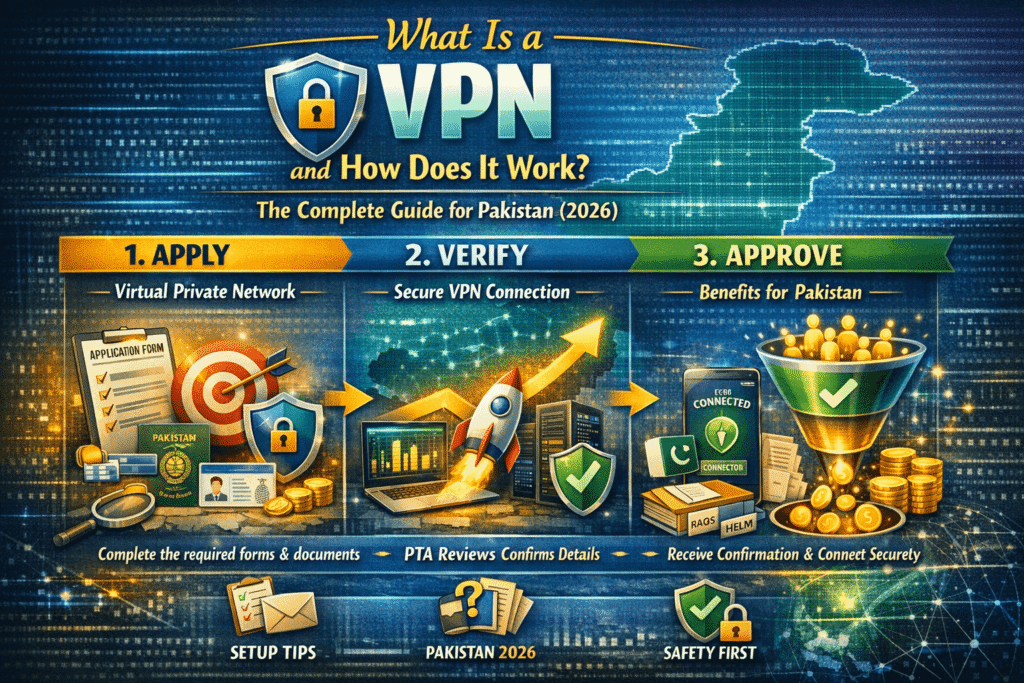
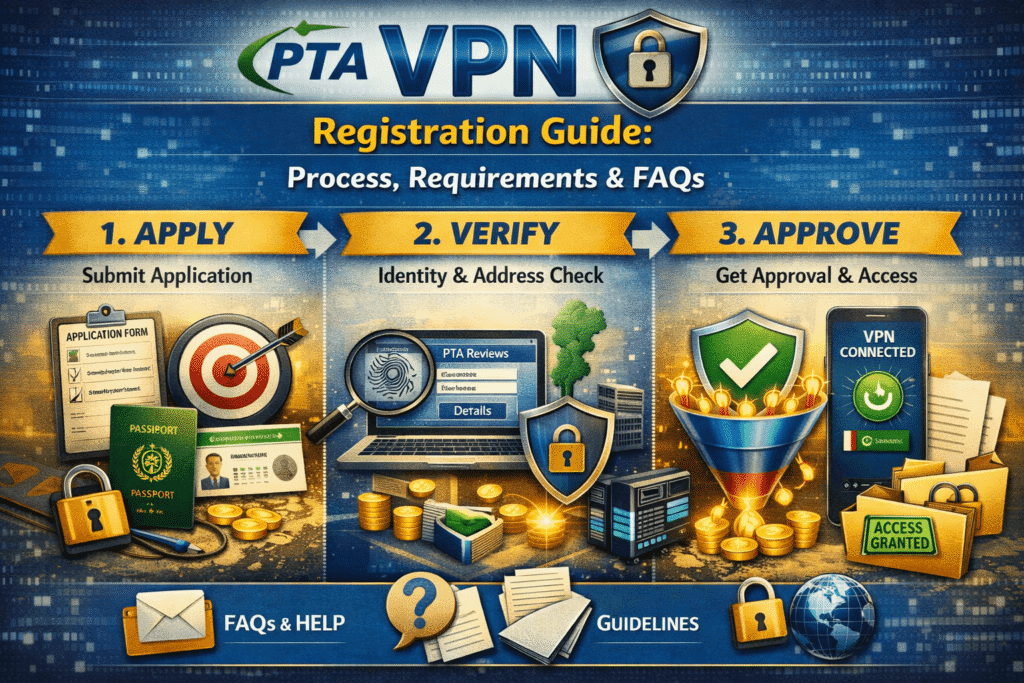
The actual registration process is entirely online and requires no physical visit to a PTA office. Here is a detailed walkthrough of each stage.
Step 1 — Gather Your Documents Before you open the portal, make sure every document listed above is ready in digital format. Scanned copies of your CNIC, any verification letter from a client or employer, and your IP address details should all be at hand. Trying to locate documents mid-application often leads to incomplete submissions.
Step 2 — Visit the Registration Portal Open your browser and navigate to ipregistration.pta.gov.pk. This is the only official portal for registration. Be cautious of third-party websites that may claim to assist with registration for a fee — the process is completely free through the official PTA platform.
Step 3 — Select Your Applicant Category The portal presents distinct registration paths for different applicant types: individual/freelancer, company, call center, and embassy or foreign mission. Select the category that accurately reflects your situation, as the form fields will change accordingly.
Step 4 — Fill Out the Online Application Form Complete the form carefully. For the VPN purpose section, be specific and honest about how you use the VPN — whether it is for accessing client servers, working on remote development environments, or handling international business communications. Vague or incomplete answers can delay your application.
Step 5 — Submit Your IP Address or Mobile Number This is the step that trips up many applicants. If you have a static IP address assigned by your ISP, enter it directly. If you are a freelancer without a static IP, use your registered mobile number instead — this option was specifically introduced to resolve access barriers for individual users who rely on dynamic IPs or mobile data.
Step 6 — Submit the Application Once everything is filled in and all supporting documentation is attached, submit the application. You will receive a confirmation that your submission is under review.
Step 7 — Wait for Approval The PTA processes applications quickly. Approvals are typically granted within 8 to 10 hours of submission for straightforward cases. You will receive a confirmation via the portal or email. Keep this confirmation safe — it serves as your official record of compliance.
Comparison Table: PTA VPN Registration by Applicant Type
| Applicant Type | Key Documents Required | IP Required? | Special Notes | Approval Time |
|---|---|---|---|---|
| Freelancer | CNIC, client letter/email, taxpayer status | Static IP or mobile no. | Mobile number now accepted instead of static IP | 8–10 hours |
| IT Company / Software House | CNIC, company reg. details, taxpayer NTN, IP address | Static IP required | PSEB members also eligible for facilitation | 8–10 hours |
| Call Center / BPO | CNIC, company details, IP whitelist | Static IPs for whitelisting | IP whitelisting enhances security and functionality | 8–10 hours |
| Bank / Financial Institution | Company reg., CNIC, NTN, IP address | Static IP required | Coordination with State Bank guidelines may apply | 8–10 hours |
| Embassy / Foreign Mission | CNIC/passport of rep., official letter, IP | Static IP required | Ministry of Foreign Affairs consulted on framework | 8–10 hours |
A Freelancer’s Journey Through the Registration Process
Consider the experience of a UI/UX designer based in Islamabad who works exclusively with European clients through an international freelancing platform. Before registration, every time internet disruptions hit, they would scramble to switch between VPN services — sometimes mid-call with a client — causing delays, miscommunication, and lost billable hours. The uncertainty was not just inconvenient; it was financially damaging.
Upon hearing about the PTA registration framework through a Pakistan Freelancers Association (PAFLA) notification, they decided to go through the process. Armed with their CNIC, a work order email from a German client confirming the ongoing project, and their NTN from the FBR portal, they completed the form on the PTA portal in about twenty minutes. Since they were working on a home broadband connection with a dynamic IP, they used the mobile number registration option that had recently been introduced.
Eleven hours after submitting the application, they received confirmation. Since then, their VPN has operated without interruption. What struck them most was not just the speed but the peace of mind — knowing that their setup is compliant means they no longer worry about a knock-on effect every time the news reports another VPN crackdown. For Pakistan’s millions of freelancers, that psychological stability alone makes the registration worth it.
What Happens If You Don’t Register?
This is a question worth addressing directly and honestly. The PTA initially set a deadline of November 30, 2024, for VPN registration, but chose not to enforce a blanket block on unregistered VPNs after that date. Instead, a grace period was offered and the registration window was extended — reflecting the government’s awareness that the IT sector cannot absorb sudden digital disruptions.
However, the regulatory direction is clear. The framework is built around gradual enforcement, not immediate punishment. What unregistered VPN users face is an increasing risk of intermittent connectivity issues, potential throttling, and the possibility that future enforcement actions will be stricter as more of the IT community completes registration. Over 31,000 VPNs have already been registered under this framework — a number that signals the momentum behind compliance.
There is also a professional dimension to consider. For businesses pitching to international clients, having a compliant, registered VPN setup is increasingly seen as a mark of operational seriousness. Unregistered operations introduce legal and reputational risk that registered entities simply do not carry.
PTA’s Commitment to the IT Sector: The Bigger Picture
It is easy to view VPN regulation through a purely restrictive lens, but the full picture is more nuanced. The consultation sessions organised by the PTA brought together the Ministry of IT and Telecommunication, the Pakistan Software Export Board (PSEB), the Pakistan Software Houses Association (P@SHA), the Pakistan Freelancers Association (PAFLA), the Ministry of Foreign Affairs, and the State Bank of Pakistan. That level of cross-sector stakeholder engagement signals a genuine attempt to balance security concerns with economic development goals.
Pakistan has set an ambitious target of $15 billion in IT exports. Internet disruptions — whether deliberate or technical — cost the industry more than $1 million per hour in lost productivity. The PTA’s VPN registration framework, when understood in this context, is not just about regulation. It is about creating a stable, predictable digital infrastructure that Pakistani IT professionals can rely on when building their reputations with international clients.
PSEB members, in particular, benefit from streamlined access to the registration facility, reinforcing the government’s commitment to supporting the formal IT export ecosystem.
Tips to Make Your PTA VPN Registration Smooth and Fast
There are a few practical steps you can take to ensure your application goes through without delay.
Start with accurate information. Even minor discrepancies between your CNIC details and the information entered in the form can flag your application for manual review, adding unnecessary hours to the process.
Use a professional verification letter. If you are a freelancer, a well-written email from your client that clearly mentions your name, the nature of the project, and the expected duration will carry more weight than a casual message. Treat this document as part of your professional portfolio.
Obtain a static IP from your ISP if possible. While the mobile number option is available, having a dedicated static IP gives you more control over your VPN environment and eliminates the need to update registration details if your mobile number changes.
Contact PTA support proactively. If your application is taking longer than expected, the PTA has a dedicated email — ipreport@pta.gov.pk — for resolving IP registration queries. Use it rather than waiting indefinitely.
Keep your confirmation document safe. Once you receive approval, store the confirmation in a secure, accessible location — both digitally and as a printed copy if needed for business purposes.
Frequently Asked Questions About PTA VPN Registration
Is PTA VPN registration free?
Yes, absolutely. The registration process at ipregistration.pta.gov.pk is completely free of charge. There are no application fees, processing charges, or renewal costs currently associated with the process. Be wary of any third-party service claiming to charge a fee for VPN registration assistance.
How long does PTA VPN registration approval take?
In the vast majority of cases, approvals are granted within 8 to 10 hours of submission. This is remarkably fast for a government regulatory process and reflects the PTA’s stated commitment to minimising disruption for legitimate users.
Can a freelancer without a static IP address register?
Yes. The PTA specifically updated its framework in December 2024 to allow freelancers without static IP addresses to register using their mobile phone numbers. This was a significant change that removed one of the biggest practical barriers for individual users.
What is IP whitelisting and is it the same as VPN registration?
IP whitelisting and VPN registration are related but distinct processes. VPN registration refers to officially declaring your VPN usage to the PTA. IP whitelisting specifically refers to getting particular IP addresses approved so that traffic to and from those addresses is permitted without restriction. Call centers and video conferencing setups in particular use IP whitelisting to ensure their operational IPs are not blocked.
Do I need to renew my PTA VPN registration?
The PTA has not yet published a formal renewal schedule or expiry period for registrations. It is advisable to check the official PTA website periodically for updates on this, especially as the regulatory framework continues to evolve.
What if I use multiple VPNs or switch providers?
If your VPN provider or the IP address associated with your VPN changes, you should update your registration details with the PTA. Using a different VPN setup without updating your registration could lead to connectivity issues.
Is it illegal to use an unregistered VPN in Pakistan?
The legal position under the Prevention of Electronic Crimes Act (PECA) 2016 does not authorise a blanket ban on VPN usage. The PTA has opted for a regulatory rather than punitive approach. However, using an unregistered VPN does expose you to potential service disruptions and, as enforcement evolves, possible regulatory consequences.
Can PSEB members register more easily?
Yes. Members of the Pakistan Software Export Board (PSEB) can avail a facilitated registration process. If your company is PSEB-registered, it is worth using that membership to access the streamlined pathway.
What email should I contact for help with PTA VPN registration?
For registration-related queries and facilitation, you can reach the PTA’s IP registration team directly at ipreport@pta.gov.pk.
What is the official VPN registration portal URL?
The official portal is ipregistration.pta.gov.pk. Always use this address directly in your browser rather than clicking links from unofficial sources to protect yourself from phishing.
Final Thoughts
PTA VPN registration is one of those processes that sounds intimidating on paper but turns out to be remarkably straightforward in practice. For freelancers building international careers, for software houses managing global client relationships, and for institutions that depend on secure digital connectivity, completing this registration is the single most practical step you can take to protect your operations right now.
The Pakistani government’s direction on VPN regulation is clear, even if the pace of enforcement has been measured. The earlier you complete your registration, the more insulated you are from the uncertainty that comes with operating outside a compliant framework. With a free process, an 8-to-10-hour turnaround, and a portal accessible to anyone with an internet connection, there is genuinely no reason to delay.
Visit ipregistration.pta.gov.pk today, gather your documents, and get compliant. Your work — and the clients depending on it — will thank you for it.