
Hotspot Shield offers both a continuing free plan and a 7-day Premium trial, so readers in Pakistan do not have to guess which one applies to them. Surfshark, which we recommend for readers in Pakistan and promote as 80% off for our users, is the paid alternative we suggest when the free plan’s limits start getting in the way, and this guide explains both Hotspot Shield options honestly.
The short answer is that the free Basic plan costs nothing and never expires, but it is ad-supported, limited to one device, and restricted to a single United States location with a daily data cap.
The 7-day Premium trial, by contrast, unlocks the full paid service for a week, including every server location and unlimited data, but it ends automatically and can turn into a paid subscription if you do not cancel.
This guide was verified against Hotspot Shield’s own pricing page and help centre, plus independent 2026 reviews, on 7 November 2026. It covers exactly who qualifies for each option, what each one costs in rupees, which devices and platforms are supported, and where the free plan falls short for readers in Pakistan.
The Short Answer: A Free Plan and a 7-Day Premium Trial
Hotspot Shield is one of the few major VPN providers that offers a genuinely continuing free plan alongside a separate free trial of its paid Premium plan. The two are different products with different rules, and confusing them is the most common mistake readers make when they search for a Hotspot Shield free trial.
The free plan, called Basic, needs no payment details and no credit card. You download the app, create a free account, and use the service for as long as you like, watching a short advertisement to unlock each block of VPN time. There is no expiry date on the free plan itself, which makes it useful for occasional, light use.
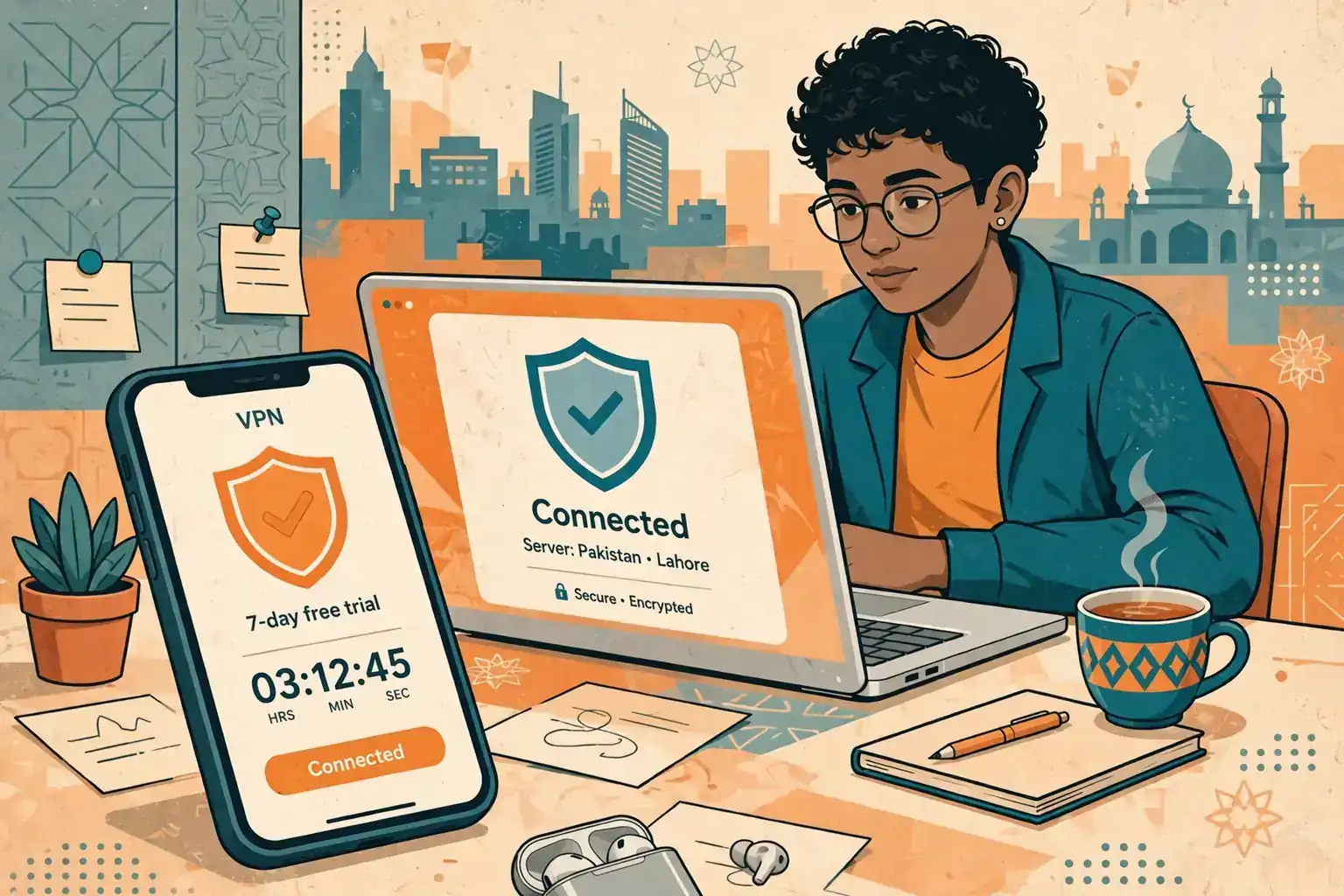
The Premium trial lasts seven days and gives you the full paid service: every server location, unlimited data, no advertisements, and up to five simultaneous connections. It is offered mainly through the mobile app stores, and the exact signup requirements depend on where you start the trial. Cancel before the seven days end and you pay nothing.
There is also a third safety net that is often confused with a trial: the 45-day money-back guarantee on paid plans. That is not free access. You pay first, use the full Premium service, and claim a refund within 45 days if it does not suit you. The differences between these three options are explained in full below.
Hotspot Shield Free Plan: What You Actually Get
The free Basic plan gives you a working VPN with no subscription fee, and that alone makes it worth understanding. It encrypts your connection with the same AES-256 encryption as the paid plan, and it uses Hotspot Shield’s own Hydra protocol, which the company designed for faster connections over long distances.
The limits are where the free plan shows its shape. Hotspot Shield’s own pricing page lists the free plan at up to 2 Mbps speed, 500 MB of data per day, one virtual location in the United States, and one device. Those are the official published limits as of November 2026, and they are the figures you should plan around.
Some other sources describe the free plan differently, and that disagreement is worth flagging honestly. A few review sites report four server locations and unlimited bandwidth on the free plan, while the App Store listing describes unlimited traffic with advertisements. Which version you see can depend on your device and app version, so treat the pricing page figures as the conservative case.
What is consistent across every source is the advertising model. The free plan is ad-supported: you watch an advertisement of roughly 15 to 30 seconds to unlock about 15 minutes of VPN access. That means the free plan works for short sessions, such as checking a blocked page or securing a public Wi-Fi connection, but it is awkward for anything longer.
Streaming is effectively off the table on the free plan. The pricing page describes only limited streaming in standard definition, and the help centre warns that services such as Netflix, Hulu, and BBC iPlayer will show an upgrade prompt instead of the video. Readers in Pakistan who want a VPN for streaming should not rely on the free plan.
The 7-Day Premium Trial: Eligibility and Requirements
The 7-day Premium trial is Hotspot Shield’s way of letting you test the full paid service before paying. During the trial you get every Premium feature: more than 3,200 servers in over 80 countries, 115 or more virtual locations, unlimited data, no speed cap, no advertisements, and streaming support.
Eligibility is straightforward. The trial is open to new users who have not already used a Premium trial on the same account or app store account. There is no published restriction for readers in Pakistan, and no regional eligibility list that excludes the country. If you can download the app from your app store, you can generally start the trial.
The trial is offered mainly through the Google Play Store and the Apple App Store, where the app listing promises seven days of Premium access. The website itself focuses on the free Basic plan and the paid Premium plans, so readers who visit hotspotshield.com directly may not see a trial offer at all. Starting from the mobile app is the reliable route.
Whether the trial needs payment details depends on the store. Some 2026 reviews report that the trial requires a card on file, which is charged automatically if you forget to cancel. Others report no payment needed at signup. The safest approach is to assume a payment method may be requested, check the confirmation screen before accepting, and set a reminder to cancel on day six.
Hotspot Shield Free vs Premium: The Full Comparison
The clearest way to choose is to compare the two options side by side on the points that matter in daily use. The free plan costs nothing and never expires, while Premium costs from around 7.99 dollars per month on annual billing, or about 12.99 dollars per month when billed monthly.
At an approximate rate of PKR 280 per US dollar as of November 2026, that is roughly PKR 2,240 per month annually, or roughly PKR 3,640 per month on monthly billing.
On devices, the free plan covers one device only, while Premium covers up to five simultaneous connections. That matters in a Pakistani household, where one subscription often needs to cover a phone and a laptop at least. The free plan also works only on Windows, Mac, iOS, and Android, while Premium adds Linux, smart TVs, and routers.
On locations, the difference is stark. The free plan gives you one location in the United States, according to the pricing page, while Premium opens more than 115 virtual locations across 80 or more countries. For readers in Pakistan, the nearest useful Premium locations include Singapore, which is the exit point most people choose for low latency.
On speed and data, the free plan is capped at around 2 Mbps with 500 MB per day on the pricing page figures, while Premium offers unlimited data with a 1 Gbps connection speed limit. In practice, independent reviewers have found the free plan faster than its published cap on some devices, but you should not count on that.
On streaming and extras, Premium includes streaming support, a kill switch, and customer support, while the free plan offers only limited standard-definition streaming and basic support. The free plan also shows advertisements, which Premium removes entirely. If any one of those differences matters to you, the trial is the honest way to test Premium before paying.
How to Start the Hotspot Shield Free Plan in Pakistan
Starting the free plan takes only a few minutes and needs no payment method. Download the Hotspot Shield app from the Google Play Store or Apple App Store, or install the desktop app for Windows or Mac from the official website. Create a free account with an email address, and choose the Basic or free option when the app offers you Premium.
Once installed, connect by tapping the power button in the app. On the free plan, the app will usually show you a short advertisement first, then connect you to its United States location. You cannot choose a different country on the free plan, so the location selector will be locked or limited to the single free option.
Before relying on the connection, verify that it works. Check your public IP address before and after connecting: the country should change to the United States and your Pakistani internet provider’s name should no longer appear. If the location still shows Pakistan, disconnect, reconnect, and check again before doing anything sensitive.
For readers who want more detail on what Hotspot Shield costs when the free plan is not enough, our Hotspot Shield pricing guide for Pakistan breaks down the Premium and Family plans with rupee conversions and renewal fees. That guide is a useful companion once you have tested the free plan and want the full picture.
How to Start and Cancel the Premium Trial
To start the trial, install the Hotspot Shield app on your phone from the Google Play Store or Apple App Store, then look for the Premium trial offer inside the app or on the store listing. Accept the trial, confirm any payment method the store requests, and check the confirmation screen for the exact date the trial ends. That date is the deadline that matters.
During the seven days, use the trial the way you would use the paid service. Test the Singapore server for speed, try the streaming services you actually watch, connect a second device, and test the kill switch by dropping your Wi-Fi briefly. A trial only helps if you test the features you will pay for.
Cancelling is done through the store, not inside the Hotspot Shield app. On Android, open the Play Store, go to Payments and subscriptions, find Hotspot Shield, and cancel. On iPhone, open Settings, tap your Apple ID, open Subscriptions, and cancel Hotspot Shield there. Cancel at least a day before the trial ends, because store cancellations can take time to process.
If the trial has already converted to a paid subscription, you are not stuck. Hotspot Shield offers a 45-day money-back guarantee on paid plans bought directly from its website, so you can still claim a refund within that window. The guarantee is covered in detail later in this guide, and it is the reason a missed cancellation is an annoyance rather than a disaster.

Hotspot Shield Free Plan Limits That Matter in Pakistan
The single United States location is the biggest practical limit for readers in Pakistan. Every connection exits through the US, which adds latency and means some services will treat you as an American visitor. That can be useful for US-only content, but it is unhelpful if you need a nearby server for speed or a specific country for any other reason.
The 500 MB daily data cap is the second limit that bites quickly. Half a gigabyte covers light browsing, messaging, and email, but a single video call or a short streaming session can use it up. If the cap is enforced on your version of the app, the free plan is a tool for short, specific tasks, not for a full day online.
The 2 Mbps speed cap is the third limit, and it is the one that makes video painful. Standard-definition video needs roughly 3 Mbps for smooth playback, so a 2 Mbps cap means buffering on video calls and streaming even before the data cap is reached. Some reviewers report faster real-world speeds on the free plan, but the published cap is what you should expect.
The one-device limit is the fourth constraint. If your phone is connected to the free plan, your laptop is not protected, and there is no way to share the free plan across a household. Readers who need protection on more than one device should test the Premium trial, which covers up to five devices, or consider a provider with a higher device allowance.
The 45-Day Money-Back Guarantee: Not a Trial, but a Safety Net
The 45-day money-back guarantee is often described as if it were a free trial, and it is important to be clear that it is not. You pay for a Premium plan first, use the full service, and then request a refund within 45 days of purchase if it does not meet your needs. The trial costs nothing upfront; the guarantee costs the subscription price until the refund arrives.
The guarantee applies to paid plans bought directly from Hotspot Shield’s website, and it is one of the longest refund windows among major VPN providers, most of which offer 30 days. That extra time is genuinely useful, because it lets you test the service across several weeks of real use in Pakistan, including different times of day and different networks.
To claim a refund, contact Hotspot Shield support within the 45-day window and request it. Keep your order confirmation and the purchase date, because the window runs from the purchase date, not from the first day you used the service. Refunds for purchases made through the app stores follow the store’s own refund process instead, so the route depends on where you paid.
Surfshark Compared: The Paid Alternative Worth Considering
Hotspot Shield’s free plan is a reasonable way to test a VPN, but its limits push many readers toward a paid plan sooner or later.
Surfshark is the paid option we recommend for readers in Pakistan, because it removes the limits that matter most: it covers unlimited devices on one subscription, offers servers in more than 100 countries, and costs from around 2.49 dollars per month on longer-term plans, or roughly PKR 700 per month at an approximate rate of PKR 280 per dollar as of November 2026.
The comparison is not close on value. Hotspot Shield Premium costs from around 7.99 dollars per month on annual billing and covers five devices, while Surfshark costs roughly a third of that on its longer plans and covers every device in the household. Both offer a money-back guarantee, Surfshark’s being 30 days against Hotspot Shield’s 45, but the monthly price gap is large enough that most readers will notice it.
Surfshark also avoids the advertising model entirely. There are no advertisements to watch before connecting, no daily data cap, and no single-location restriction. For readers who tried the Hotspot Shield free plan and liked the idea but disliked the limits, Surfshark is the natural next step, and the free-plan experience itself is a good test of whether you need a paid VPN at all.
Surfshark — our recommended VPN for Pakistan
If the Hotspot Shield free plan feels too limited, Surfshark covers every device in your home for less than the cost of a Premium plan.
Privacy on the Free Plan: What the Ad-Supported Model Means
A free VPN has to pay for its servers somehow, and Hotspot Shield’s answer is advertising. That is a legitimate business model, but readers should understand what it means for privacy. Independent reviews note that the free plan’s privacy policy allows some data to be logged and shared with third-party advertisers, which is how the advertisements are targeted.
That does not make the free plan unsafe for casual use, but it does mean it is a poor choice for anyone whose main reason for using a VPN is privacy. If you want a VPN so that your browsing is not tracked, an ad-supported free plan works against that goal, because the advertising system itself involves tracking.
The Premium plan removes the advertisements and operates under a different privacy arrangement, though Hotspot Shield’s logging practices have drawn criticism in independent reviews, and readers who want the strongest privacy assurances should compare providers on that point specifically.
Our Surfshark free plan and trial guide explains how the recommended alternative handles trials and refunds, and our NordVPN free plan and trial guide covers another major provider’s trial rules for comparison.
Pakistan-Specific Considerations
Readers in Pakistan should know that Hotspot Shield’s free plan has no Pakistan server, so every free connection exits through the United States. That adds latency to every request, and it can confuse services that expect a Pakistani location, such as local banking apps or government portals. Keep those services on a direct connection, or use a provider with a nearby server.
Payment is the second Pakistan-specific issue. The free plan needs no payment, which is an advantage where international card payments sometimes fail. The Premium trial and paid plans, however, are billed in dollars, and a failed card payment can interrupt the service. Confirm that your card works for international online payments before starting a trial that may convert to a subscription.
The Pakistan Telecommunication Authority operates a registration system for VPN use, and readers who use a VPN for work or business should check the current PTA guidance for their situation. This guide does not give legal advice, and the regulatory position changes, so check the PTA’s own announcements rather than relying on any single article.
Limitations and Who Should Skip the Free Plan
Skip the Hotspot Shield free plan if you need a VPN for streaming, video calls, or a full day of protected browsing, because the data cap, the speed cap, and the single location will frustrate you quickly. Skip it too if privacy is your main concern, because the ad-supported model involves the kind of tracking a privacy tool is meant to prevent.
Keep the free plan if you need occasional protection on one device for short sessions, such as securing a public Wi-Fi connection or reaching a blocked page. It costs nothing, it needs no card, and it is honest about what it is. For anything beyond that, test the 7-day Premium trial properly, then decide with real experience rather than marketing claims.

Frequently Asked Questions
Does Hotspot Shield Offer a Continuing Free Plan?
Yes. Hotspot Shield offers a continuing free Basic plan that costs nothing and has no expiry date. It is ad-supported and limited to one device, one United States location, up to 2 Mbps speed, and 500 MB of data per day according to the official pricing page.
Does a Hotspot Shield Trial Require Payment Details?
It depends on where you start the trial. The 7-day Premium trial is offered mainly through the Google Play Store and Apple App Store, and some reports say a payment method is required while others say it is not. Assume a card may be requested, check the confirmation screen, and cancel before day seven to avoid being charged.
Is a Refund Guarantee Different From a Free Trial?
Yes. A free trial gives you full Premium access for seven days without paying first. The 45-day money-back guarantee requires you to pay for a Premium plan first, then claim a refund within 45 days of purchase if the service does not suit you.
How Much Data Does the Hotspot Shield Free Plan Allow?
According to Hotspot Shield’s pricing page, the free plan allows 500 MB of data per day at speeds up to 2 Mbps. Some app store listings and reviews describe unlimited bandwidth on the free plan instead, so the exact limit can vary by device and app version.
Can I Use Hotspot Shield Free on More Than One Device?
No. The free plan covers one device only. The Premium plan covers up to five simultaneous connections, and the 7-day Premium trial unlocks the same five-device allowance for the trial week.
Does the Free Plan Work for Streaming in Pakistan?
Not in any practical sense. The pricing page describes only limited streaming in standard definition, and the help centre warns that Netflix, Hulu, and BBC iPlayer show an upgrade prompt instead of video. Readers who want streaming should test the Premium trial or a paid plan.
Conclusion
Hotspot Shield gives readers in Pakistan two genuine free options: a continuing Basic plan that costs nothing but is limited to one device, one US location, and a daily data cap, and a 7-day Premium trial that unlocks the full service for a week. The free plan suits short, occasional sessions, while the trial is the honest way to test whether Premium is worth paying for.
Whatever you choose, read the confirmation screen before accepting a trial, cancel a day early, and remember the 45-day money-back guarantee if a trial converts to a paid plan. And if the free plan’s limits convince you that you need a paid VPN, choose one that covers every device in your home at a price that makes sense in rupees.
Surfshark — our recommended VPN for Pakistan
For readers who outgrow the Hotspot Shield free plan, Surfshark covers unlimited devices with no data caps and no advertisements to watch.